Showing posts with label Mexico. Show all posts

Saturday, February 15, 2014

AN EXPLOSION OF IMAGES

If you have read this blog previously you will recall that I wrote about the number of religious images where I assumed this revewaled a process of democratization of religious power.  No longer centered in the institution nor in a single image (Christ or Guadalupe) power is transferred to simple images in metal or to photos, posters, small replicas of a saint.  Here I want to talk briefly about the history of this process.
Is this just an example of consumer "stuff" or is it a display of power?


I have been reading Religion for Atheists by Alain de Botton and found it fascinating and challenging.  His basic thesis is that as the West became increasingly secularized we began to dismiss any religion (God was dead) and in this process we threw out the baby with the bathwater - or perhaps throwing out the bathwater with the baby.  After 2500 years of history we havediscarded everything  these religions knew about the problems of the "soul"and the building of community.  I will return to this book in a separate post but here only want to report on a little history.

The Romans had many gods and deities resulting in a multitude of temples and alters.  Each of these gods were believed to have a special power and so were sought out by those with specific needs.  In 312 AD Emperor Constantine was on his way to an important battle when he had a vision during the night.   In this vision he saw an image of a Christian word above him.  He awoke and had his troops paint this image on their shields.  They were successful in the battle and he believed it was due to the Christian image.  He subsequently legitimized Christianity by converting.   The Christians, not being fools, set about replacing all of the images and temples of the Romans with their own alters and temples.  Many of these placed a deity with a specific characteristic which corresponded to what was considered sacred locally.  As a result there were saints who performed miracles, others who provided relief for dental problems, marital problems, and so on.  In about 411 AD the Christian church declared that a simple piece of linen could be used to touch a sacred image and thus transfer the power of that image thus allowing you to take this power to your home.  As a result a market was created for a multitude of "handkerchiefs" as well as replica saints.   This is the process of democratization I referred to in an earlier post.  Attaching specific deities to a local location also fostered, probably unintentionally, travel which was to be undertaken for enlightenment and problems of the "soul".  (Now travel is to provide us with entertainment, knowledge or just as a time to see the sights - but what sights do we see?)

When the Spanish conquered Mexico they introduced the same polices.   When ever they found a site sacred to the local people they erected a cross or built a church.  I recently visited the city of Puebla and small town of Cholula.  In each of these locations you can't help but be struck by the number of beautiful churches.  In Cholula which was a sacred site for the large pre-columbian population Cortez vowed to build 365 church, one to replace every temple he had destroyed.  I think you would be hard pressed to find all these churches but there are indeed many churches and some of the most amazing in the county. One of these is the church of the Virgen de los Remedios begun in 1574 (replacing a cross that had twice been destroyed by lightening.  The image of the Virgin (only 27 cm high) was apparently brought from Spain with one of Cortez's troops who buried it after a terrible defeat by the Aztecs.  During the next battle the Spanish troops saw a young girl throwing dirt into the eyes of the Aztecs resulting in their defeat   Perhaps the young girl was the Virgin herself .  The image was thought to have brought them success.    The church itself is built on top of one of the great pyramids of the world.  Cortez probably wasn't aware that a pyramid was there as it had been vacated and was covered in trees and grass. Exploration of the pyramid was first begun in 1930 and while a small section has been reconstructed it is still covered in grass and trees.  The image of the Virgin was first referred to as Our Lady of Victory, but in 1594 was renamed the Virgin of Remedies. For the indigenous peoples the site was associated with the god of rain.   It is still a sacred site for the indigenous population (being one of several sites visited by the Conchero dancers each year) as well as for Catholics.
A view of Los Remedios as you climb up the pyramid.


The small section of reconstruction with the top of Los Remedios just showing on top of the pyramid.

Inside of Los Remedios with the small virgin (27cm tall) above the alter.


These few details helped me to see that the process of the Christianization of Mexico was not unique and the presence of a plethora of religious images goes back almost 1600 years.

A few more words on the image of the Virgin.  Upon seeing the Virgin I was convinced it was the same image as found in Patzcuaro, Neustra Senora de la Salud.  Although the image in Patzcuaro is much larger and made by the local idigenous population of pasta de cana it bears a remarkable likeness to that at Los Remedios.  One exception is that the Virgin of Los Remedios is carrying a small Christ child in her am.  One often wonders where Vasco de Quirroga found the inspiration for his image; it now seems possible it may have come from Cholula.  Indeed he may have known the image in Spain.
A photo of the replica of the Virgin of Los Remedios.  Notice the moon at the bottom and in her hands there is a small Christ child.

La Senora de la Salud during a pilgrimage in Patzcuaro.  Notice that she holds a rosary in her hands (but the original in the basilica has a small moon at her feet).

Reading:  Alain de Botton, Religion for Atheists.

Wednesday, July 18, 2012

SHAKING BELIEFS

I’m sure you have had this experience.   You read something and soon discover that you really hadn’t understood something you previously believed you were familiar with.    I recently had this experience twice in one week - enough to shake ones sense of reality.

The first “shake” occurred while reading Wade Davis’ recent book on the life of George Mallory (Into the Silence).  The book casts a sufficiently wide net to allow the reader to set the first attempts on Mount Everest in a political and cultural context and there is sufficient detail on the actual climbs that one feels you were there.   One element of that broad context was World War 1 as all of the members of the first attempt on the mountain had been in the war or experienced the loss of countless family and friends.  Davis’ account of World War 1 is graphic and at the same time almost poetic; an amazing piece of writing.  I have been privileged to be part of a generation for whom war was not a personal reality; I knew from an early age I was not going to join the military and given the times was quite anti-military.   However, my father and two uncles had been in World War 2, my wife’s uncle had died in World War 1, but that is now 90 years in the past and an aunt I never knew lost her husband in World War 1.  So, I had to ask myself why I never knew, or cared to know, about the most terrible war in history.   Why didn’t the numbers of dead from that war ever get through to me previously?  I really don’t know.   I did, however, go back through family histories and very quickly came up with a list of 16 men who had served in the war, 4 of whom died from injuries. So now this was has my attention.  Primarily in terms of the social consequences of this horrendous event on communities and on societies as well as on individual men as in the story of George Mallory.

The second shake was on reading Massacre in Mexico (1971) by Elena Poniatowska.   Poniatowska spent her career as a journalist and when it came to the two most significant events in Mexican history of the past 50 years she developed a very modern style.   Rather than tell her story or attempt to provide an analysis of the event she simply let people speak for themselves.  Almost the entirety of the book is made up of short clips from interviews with people.  It is like reading a contemporary twitter feed from the front lines.  The reader gradually pieces events together and forms a powerful image of what happened.  The event of course was the state killing of approximately 320 students at the Plaza of Three Cultures located at Tlateloloco just days before the 1968 olympics were to begin in Mexico City.   Student protests had been going on for some time regarding significant issues of the time (not about tuition, etc) and as the Olympics approached it seemed that the government made a decision to bring events to a close.  Although there is not a strong consensus about events because of the technology available and the ability of the government to control the press and to intercept any photos which may have come out of the plaza.

The strong view, and I think the right view, is that the military prepared and then virtually trapped the students in the plaza and assisted by an armed helicopter and forces with machine guns, bayonets, and guns set about killing as many people as they could.   We have become accustomed to the police roughing up protesters and occasionally wounding them or, as in the case at Kent State University, killing four and wounding 9 others. More intentional incidents are associated with communist states like China (Tiananmen Square, 1989) or autocratic states where dissent is not tolerated and few are able to resist without serious repercussions.   But here was Mexico, our neighbor, engaging in behaviour which should not have been tolerated at a state level.   Further, I was old enough and developing sufficient political consciousness to be more aware.  The 1967 Detroit Riots were close at hand, resulting in 43 deaths. and this did shape my political awareness of the USA.  I should have known to expect the worst of politicians.

I have now started reading Thinking, Fast and Slow and things may never be the same for me.  Although, for any thinking person, it is not new, the way the author frames the analysis is does leave you at least trembling.


Wednesday, June 20, 2012

MARTHA STONE ON THE CONCHEROS

 Martha Stone:  At the Sign of Midnight: the Concheros Dance Cult of Mexico. (1975)

It was with some surprise that I read Martha Stone’s 1975 book on the Conchero dancers.   I now wish I had read it much earlier to avoid months of flailing about in attempts to understands this dance.  Although published in 1975 Stone was living in Mexico City and began to document the dance as early as 1940 and continued for 20 years, becoming a dancer and rising to the position of capitana.  Here then is a first hand account of the dance from an insider’s perspective and showing a real effort to understand the dance.  The book is written in an informal manner, introducing you to many of the participants, revealing internal tensions, and more importantly showing you much more than the dance itself.  The dance is what most of us are familiar with but the dance is supported by a wide range of other activities.  Events such as vigils which are often held prior to a dance, the death of a member, initiation of new members, loyalties, obligations, discipline, creation of the Xuchil, passing of leadership, a 'conquista', raising funds in order to create new banners as well as the everyday travails of quite poor peoples.  Stone attends events (always on invitation) in Mexico City and gradually travels to much more distant places thus providing a sense of the difficulty of travel and often being protected by the leader of a group who had presented the invitation.  She was deeply accepted by those who knew her but was under suspicion when other troops were around.  The tale of her going to the bell tower with her husband (on instructions of the dance leader) only for her to be requested to go down and then threatened with jail.  The problem was that women were not allowed in the tower.  Or the tale of a serious train accident, a train she was supposed to be on, where many of the dance troop were killed while on route to a dance in Jalisco.  I came away with a sense of how busy their schedule was; the dance was a way of life.

The reader gets a very strong impression of how Catholic the dance was (and is) and many of the symbols used can be seen to have a Christian interpretation.  For example, at one point two men declared they were going to dance without their shirts and the leader was so outraged that they were to be disciplined. (Presumably because it violated church practice.)  Discipline consisted of a few lashes to the shoulder or back as well as things like being excluded.  However, as I read all  of this I obtained a strong impression that Catholicism was really a disguise to satisfy the authorities and at the same time allowing them to continue ancient beliefs. In short, it may well be pre-Hispanic.  Stone is quite convinced the dance is pre-conquest and does present suggestive evidence gathered from historical documents and from the creation of this oral history.  The senior members of the dance group are very able to talk about the origins of the dance and while some of these stories don’t hold up to examination others do leave you wondering.  In addition, most of the dancers she spoke to identified as Otomí.  She includes an intriguing story about a piece of paper.  For years she wondered what was in a small bundle often placed at the back of the altar.  Much later she shows a senior dancer a copy of a depiction of the dance from a book about the pre-conquest peoples.  Soon after this the same dancer takes her into a closed room and opens the small bundle in which was a similar depiction of the early dance. I wish she had explored this in more depth.

She traveled to many events, including:  October 15, in San Miguel de Allende, February 2 in San Juan de Los Lagos, Jalisco, during carnival in Amecameca, in Huejotzing, Puebla, Taxco, first Friday during Lent in Chalma, the fourth  Sunday in Acopilco, June 16 and December 16 in Tenancingo, September 18 in Los Remedios, December 12 at the Villa de Guadalupe, as well as Tlaltelolco and Ameyalco.  These being the main events which people who have made a “promesa” must attend. 

Also of interest in understanding the Choncheros is a piece by Gertrude Kurath from 1946 - "Los Concheros" in Journal of American Folklore 59, 1946:  387-399.  Kurath makes a few valuable observations:   1555 First Provincial Council meeting ruled that the natives should not be allowed to dance.   In 1585 ruled that they should not be allowed to wear headdresses.   Also in 16th century rules about teaching - it must in Spanish.  But in the rural areas the priest and others often ignored these rules.

Overall an enjoyable read with a much more wholistic view of the dance than you can obtain from other readings.  I have written several posts on the Conchero (or Aztec) dance which you might wish to check out as you will find photos there.   See the following:
Concheros dance

Or, Aztec dance

Monday, June 11, 2012

NIGHT OF THE DEAD AND THE OLD MEN

Let me be a little personal to start this post.   I have spent quite a bit of time in the state of Michoacán, Mexico and quickly became enamored of the dances and festivals.  Now that I think about my own reactions/perceptions I note two things somewhat unusual:  I never went to Janitizio except to allow visitors to have a look and I much preferred events where there were no tourists and especially no “gringos”.  The later often required trips somewhat distant from Pátzcuaro.  Although I am a news junkie I had never been aware of how central Michoacán was to national tourist promotion and even to national unity.  It is after all one of the poorest states in the republic, has more than its share of narco-traficante action and the indigenous peoples are amongst the poorest of the state. I arrived in Michoacán with no preconceived ideas of the peoples or events and very gradually came to love the place.  It should be noted that I am Canadian and Canada's relationship to Mexico is still quite different that that of the USA.

It was with surprise and pleasure that I read Ruth Hellier-Tinoco’s book, Embodying Mexico:  Tourism, Nationalism and Performance (2011) which provides a very well researched and documented study of Michoacán from about 1920 to the present.  She shows very clearly how the Island of Janitzio was “discovered” by state intellectuals and the media in 1922 (see note) and their realization that both the night of the dead celebrations and the dance of the viejitos could serve much broader purposes for the nation.  The context for all of this was the virtual civil war that occurred from 1910-1920 with the overthrow of the Porfirio Diaz (president from 1876-1911) regime.   With the new found stability of 1920 came the need for a truly national state and this depended upon Mexicans having a strong sense of who they were and something to share that might provide for unity.  In a sense there was a need to create an “imagined community”.  Into this vacuum and this need came Rubén Campos [musicologist], Francisco Domínguez [artist], Frances Toor [anthropologist], Moisés Sánez [undersecretary of education], Carlos González [also a state representative] and I.L. Kandel [a guest].  (Two of these members received government funds to return to Michoacán in 1923 to collect folklore.) On that night they arrived by canoe to the Island of Janitzio in lake Pátzcuaro as simple observers for a short while before returning to shore.  The island at that time was not appreciative of visitors and it a marvel that the newcomers were not thrown off; perhaps the visitors were protected by their official look.  They managed to take some photographs and saw the night of the dead activities.  They also took a canoe to the island of Jarácuaro where they saw the dance of the viejitos (the old men) and in 1924 took Nicolás Bartolo to Mexico City to teach others to perform the dance and the first stage event took place that year.  Nothing was to be the same and at the same time everything had to be same.  Approximately 100,000 visitors arrive each year to observe night of the dead in the region, exactly as did the six visitors in 1922, and the viejitos dance, or their image, is everywhere.  At the same time it was important that these two events not change and tourists today can recreated the 1922 trip  for themselves.
Shot in Jaracuro rather than Janitzio but showing the classic scene-women wrapped in rebozos and kneeling before candles.  However now they almost always bring small chairs.
This is not close to the classic scene as it shows a man before the grave, a not uncommon sight.


Who were the Mexicans?  Porfirio Diaz (president from 1876-1911)  identified with France and one can see many signs of this in the avenues and architecture of Mexico City.  The elite typically looked outside of Mexico for models with which to identify.  Now what was needed was something from within.  Why not look to the past, to an indigenous past?  If so the right narrative, and image, had to be constructed.  The indigenous of Michoacán provided the model especially those around lake Pátzcuaro.  The viejitos danced in what can be seen as typical indigenous clothing (white pants and top with embroidery, sandals, a beribboned hat and pink mask) so they can be presented as pan-Mexican.  The clothing contains the image of the past and of truly “authentic” indigenous peoples.  The night of the dead provided a female image, rather than the male image of the dancers, and again the simple image of indigenous women wrapped in a rebozo kneeling before candles and a grave met the need for something “authentic” and yet indigenous.  Finally the ability to create a sense of remoteness or isolation and thus pre-modern was easy with canoe trips and even with modern launches. 
This shows the most typical scene in the Patzcuaro area-4-5 dancers and the band behind them.
This a group far from the lake region: the clothing is similar but there are more dancers and they tend to dancers in lines or with other dancers.
.
Here we have an example of the entertainment aspect of the dance, the dancers dancing fast and appearing to levitate.

The narrative suggests that this is where all of Mexico originated - in rural and indigenous communities.  What of course was implied in all of this was that the real people (not the imaged) were primitive and underdeveloped.  Primitive or backward rather than modern, rural rather than urban, indigenous rather than mestizo.  How to make all of this fit?  One option was to promote economic development. We saw this in the 1936 construction of the enormous image of Morelos by president Lázaro Cárdenas (born in the state and president from 1934-1940 and governor of the state prior to that), an indigenous hero of the first revolution, atop the Island of Janitzio, construction of roads to allow visitors access and the creation of CREFAL in 1950 (located in the Pátzcuaro house of former President Lázaro Cárdenas) to foster economic development projects around the lake.

The discussion above is short on specifics whereas Hellier-Tinoco is long (so to speak).  Much of the above activity took places under the auspices of the federal secretary of education (the same agency that hired Diego Rivera in the 1920-30 to create mural images that spoke to who Mexicans were) since education was seen as central to the construction of a national identity.  Students were taught about the two activities discussed, images of the dancers and night of the dead were used extensively in advertising (and as she points out the people seldom paid), world fairs presented these images as the “soul of Mexico", corporations used the images, and beginning in the 1930 dance performances were staged to highlight the viejitos and then in 1950 the national Ballet Focklorico was created to present the viejitos on a grand scale in the Bellas Artes building in Mexico City.  The viejitos were taken on tours of the United States and Europe and anthropologists and archaeologists were invited to Michoacán and to much of Mexico to uncover the indigenous past with work on the site at Ihuatzio, Michoacán (excavated and opened to the public in 1937-38 and currently undergoing further development) and the ruins in Tzintzuntzan, Michoacán (also excavated in the 1930s).

Little did I know that two events from Michoacán would come to stand for the “soul of Mexico”.  The trouble for Michoacán of course is that it becomes difficult if not impossible to escape the framework created almost 100 years ago. It's folklore and folk art or starve as other cultural activities and artistic endeavors are ignored and economic development still waits.

Note: #1.  The author does not say exactly when the trip to Janitzio occurred but I have selected 1922. It may have been 1923 as Frances Toor an American anthropologists only arrived in Mexico in 1922.  One wonders how she so quickly achieved the confidence of those in power.  In 1925 three of the people involved published articles related to their journey and in the same year Toor began publishing her famous journal, Mexican Folkways.

Note #2:  One often hears that the dance of the old men has its origins in the encounters of the indigenous an the Spanish with the dance been a bit of a spoof.  This may not be true as a reference to the dance is made as early as the 16th century and it appeared to serve very local purposes.  However, the dance is uniquely Purépecha.

You can expect me to return to this subject as reading about Frances Toor has led me to the excitement of the 1920s in Mexico City.

Friday, May 11, 2012

CONCHERO DANCERS

This post is a third or fourth attempt to describe the Conchero (or Aztec) dancers of Mexico. (To see my earlier post go to  Aztec Dance.)  I have just read Susanna Rostas’s book on the Conchero dancers -Carrying the Word- and looked particularly at the historical section where she attempts to give an idea of where these dancers came from.  The book itself is a marvel in that it gives the reader a very good sense of the difficulty of understanding any dance in Mexico.  They all must have a long and complicated history and as the dancers themselves were preliterate (her term) it is difficult to get to the bottom of anything.  I have also been reading Ruth Hellier-Tinoco’s book on the viejito dancers of Michoacán which focuses on the way this dance was appropriated by the state for nation building purposes during the 1920s.  It leaves the reader with a profound sense of the complexity of understanding.  The centuries of preliteracy with a few written words by Spanish priests of Rostas’ book turns to a detailed examination of documents and interviews in Hellier-Tinoco’s book and you come away thinking:  “how can we understand anything”.

Having said that,  this post is an attempt to review the section of Rostas’s book which focuses on the history of Conchero dancers, primarily chapter 9 titled “Oral tradition, Myth and History”.  This is a difficult chapter to read so here I pull out what I believe to be the essence of the chapter.

The concheros themselves have a founding myth which places their beginnings in the Bajio region of Mexico: a region to the North West of Mexico City best known today by the cities of San Miguel de Allende, Queretaro, Guanajuato, and as far south as northern Michoacán.   The myth describes a battle between the Spanish and the Chichemaca Indians in which Santa Cruz (essentially the Holy Cross of Christendom) and Santiago (the patron saint of Spain and Mexico) appeared during the heat of battle; the Chichimecas put down their arms and converted to Christianity.  They demanded that a cross be raised and they danced around it for days.   One of the songs of the Concheros continues to make reference to this newly erected cross and the battle.  There is also a document prepared by a Spanish priest (probably in 1744) which recounts a version of this story.   What is significant about the story is that it gives the dance of the Concheros a Catholic origin, making the dance Christian rather than indigenous.  It also locates the dance outside of the domain of the Aztecs.  Having said that, it is not at all clear exactly what the dance was.

If the above story has any truth it might suggest that the dance itself is a version of the dance of the Christians and Moors, a dance introduced by the Spanish as a tool in their conversion of the indigenous peoples of Mexico.  There is a 1643 document which described a version of the dance of the Moors (performed for the celebration of Santa Cruz) in the state of Michoacán which describes the various roles of the dancers.  These roles were probably standard roles of the confraternities established by the Spanish as a way to ensure the continuity of dances.  It is significant that these roles (and terms) are still used by the Concheros today.  Over time confraternities gradually diminished in Mexico and became more like secret societies.  Until quite recently the Concheros themselves were family based organizations which one had to be born into.  More recently one could be invited but a large number of the groups are still primarily family based. 

In the 18th century the state attempted to block the publication of documents which might praise the Aztec past.  After the revolution of 1810 Catholicism became the legal religion of Mexico but by the mid-eighteenth century attempts were made to prohibit public celebrations around carnival for fear of riots.  In 1828 a law was passed making clandestine meetings punishable.  In 1857 Benito Juarez led an attack on the church by removing property and limitings is powers.   All of this eliminated confraternities or drove them underground until the end of the century when an attempt was made to heal the rift between church and state and once again pilgrimages were allowed to the sacred site of Guadalupe.  What is important about this 100 year period were three things:  the attempt to diminish public dances (although probably mostly in large urban areas), the weakening of the church and the virtual disappearance of confraternities.  Although there were exceptions, the Conchero dancers went underground or disappeared but the confraternity aspect of the dancer groups remained (things such as looking out for the needs of its members).

The turn of the century (1900) brought with it rapid urbanization as many from the countryside migrated to Mexico City; among those migrants were Conchero dancers and their confraternities which had survived.  But another revolution led to laws making public dances illegal and all of this led to the period of the Cristeros (those attempting to re-establish  the church).  President Camacho (1940 to 1945) was to declare himself a Catholic and the image of Guadalupe was brought out of hiding and placed in a refurbished Basilica.  Slowly, public dances gained importance and the umbrella of religious organization prevailed.  Two others things were going on at this time which impacted the indigenous population and the Concheros. 

The first was the attempt to create a national identity.  After 1910 it became important to establish a national identity for Mexicans and the Indians were to play a part in this.  Although it is too simple to claim that prior to this the society had been racist,  a new interest was shown in the Indians with an effort to document their history and cultures.  Although there was still an interest in the assimilation of the indigenous peoples, for their own good of course, it was believed that the past could establish a sense of what it meant to be Mexican.   (For a marvelous account of this period in Michoacán see the 2011 book by Ruth Hellier-Tonico, Embodying Mexico:  Tourism, Nationalism and Politics.)  There was ambivalence in this of course as it was difficult to study and identify with the past and not see the numerous examples of living  cultures.

The second was the reorganization of the Concheros.   Starting in the late 19th century a standard was raised in Mexico City (a standard is the banner the group carries and states their founding date among other things).  Then in 1920 an attempt was made to  develop an organization of Conchero dancers - in fact two such organizations appeared - and for the next 40 years these brought the past forward and provided the vehicle for the stability and spread of the dance in Mexico.  However, by 1960 the family or confraternity basis of these organizations began to give way and new members were invited in.  It was at this time that a renewed interest in the Aztec past appeared and this climaxed in the 1992 celebrations for the 500th anniversary of the “discovery” of North America.   At this time it became increasingly clear that the Conchero dancers were no longer primarily a Catholic and spiritual organization and the Aztec style was fully entrenched.  In short,  the Mexica dancers became fully established and the Conchero dancers, while still spiritual, took on Aztec dress styles.

My apologies to professor Rostas for any errors made in this attempt to make a (somewhat) coherent story of a vast array of events.


Readers may also want to check out the article by Arnoldo Carols Vento - Aztec Conchero Dance Tradition: Historic, Religious and Cultural Significance.  Wicazo Sa Review
Vol. 10, No. 1 (Spring, 1994), pp. 59-64

And, Martha Stone's 1975 book  At the Sign of Midnight:  The Conchero Dance Cult of Mexico.

Saturday, March 24, 2012

CARNIVAL AS MAKING COMMUNITY VISIBLE

If you are a regular reader of this blog you may rightly have concluded that I am obsessed with “community”.   You would be right since I believe I see community much more directly in Mexico than I do in Canada.  Now you may well say, “here he goes again”.

We recently attended a carnival event in a small pueblo, an almost immediately I said, “now this is community”.  Quite different than the block parties I am accustomed to.   The event began with many members of the community gathering in the centre of town and then forming a parade of sorts with the mandatory band keeping everyone on track and bottle rockets telling everyone else to get a move on or they would miss the festivities.   At the head of the parade was a burro, nicely adorned with ribbons and balloons and more importantly, carrying the beer.  The destination was a dusty and rocky intersection about 500 meters from the pueblo.
The men unload the beer.


At this intersection a small slice of community life was enacted.   Women had brought food, tables were set up and those who wished could sit down to eat.  Since carnival in this region is often about cross-dressing there were a number of men in tight dresses, pantyhose and high heels.   Two or three of the men wore masks.  The women too assumed roles of men although they didn’t really cross-dress.  Instead they carried hand-carved wooden swords whose symbolism said -”we are men”.  Other women acted like the male cargueros of other events in that they wore cowboy hats, had the essential woven bag over their shoulders and carried and distributed the tequila to all assembled.   Aside from eating the main event was dancing.   The male-women went into the crowd and brought other men to the dance floor, young women did the same and it was in this way that we were invited to the dance “floor”.   My partner was a young woman who had flown home from Los Angles just for this event.   The old women stood together in their dark clothes, with colourful confetti in their hair, rarely smiling and talking quietly among themselves.  There were very few old men. 
Did I mention that the dresses are tight.

Here we see the women with their swords.


After an hour of dancing the group returned to the pueblo, gathering in the basketball court where the local farmers had arrived with wheelbarrows full of fruit and vegetables which they distribute to the crowd.  Everyone then went home for a while before reassembling for a dance which went on late into the night.   If the men became too drunk the women, perhaps the ones with the swords, were entitled to lock them up for the night.


So, we saw elements of many Michoacán carnival events - the torito and cross-dressed men taunting the bull and then forcing men to dance with them.  But, more importantly for me, we saw all of this performed in a community setting.  All were linked together through some connection to this little place, all categories of the community were present and a strong sense of making things happen for their own entertainment and fulfillment of traditional responsibilities.

Sunday, February 26, 2012

RE-DESCRIBING THE AZTEC DANCERS


Readers of this blog are now familiar with my returning to a topic time and again as I gain more knowledge or simply rethink a topic.    This blog does exactly that as I take another run at the notion of the Aztec dance mentioned in two previous post, one on my experience in San Miguel De Allende during el dia de la conquista and the most recent on our visit to the Basilica de Guadalupe in Mexico City.   On both occasions I wrote after having read the thoughts of Max Harris which you can find in his book Carnival.   Now I have found the anthropologist that Harris relied on for some of his commentary and this reading has given me new insights and raised new problems.  The works of Susanna Rostas focus on the dance of the Concheros (often described as Aztec dancers) and the dance of the Mexica (who more genuinely may be considered Aztec dancers, but the term that has become more popular, and more accurate, is Mexica).   It is often difficult to distinguish between these two groups and they do on occasion dance together, so it might be helpful to others if I present a brief review of what I believe Rostas is saying.
These 3 photos give a general sense of the attire.


This group may well be Mexica:  they are young, not dancing in a circle but more on their own and are very showy.


If you have seen groups of dancers with substantial feather head-dresses, often wearing partial masks representing animal figure and wearing “costumes” with bead work, patterned clothing that looks Aztec-like and bells on their feet, these are very likely one of the above two groups.  Here is how Rostas distinguishes the groups.
Concheros
1. Central to their performance is the use of a stringed instrument that we might call a mandolin (introduced by the Spanish) and often with the shell of an armadillo as the backing.  This shell is called a conch, hence the name of the dancer.
2. The dancers are primarily spiritual and the dance includes many rituals.   The dance begins with a required ritual including turning to the four cardinal points,  asking permission of God, or the spirits,  to dance and drawing a cross with a foot.
3. Dancers cover a substantial part of their bodies (although this is changing).
4. A visit to the church at the site of the dance was required.
5. The leader of the group dances in the centre of the circle and invites other dancers to join him or to lead for a part of the dance.
6. The goal of the dance is  a form of transcendence in which the ego is available for change or improvement.
7. The dance itself is performed slowly.
8. Dancers are men and women and tend to be middle aged.
Here we have a dancer with the mandolin.

Here is the home base of a dance group.  If you can zoom in you will find about 7 mandolins (several with the armadillo shell) and only one drum to keep the rhythm, an image of the Virgin, many incense burners and a flower design on the pavement.   This design is a custom of the Concheros and is usually of a cross (in this case rather stylized).

Mexica
1. The drum is the essential instrument as the mandolin is seen as too Spanish.
2. Dancers are primarily in to performance and politics.  No ritual is required to begin the dance.
3. Dancers expose a great deal of the body.
4. Dancers seldom visit the church and tend to be non-religious in the Christian sense.
5. There is no leader and the dancers often appear to be in competition.
6. The goal is the presentation of a self that is already formed and to the making of a political statement - the need to return to a state prior to the arrival of the Spanish.  They are offering a new sense of identity.
7. The dance is performed quickly in a competitive state.
8. Dancers are young and predominately male.
An indication that this group is Concheros is the number of women participating.


If you have read my previous post you can now see that it is the dance of the Mexica that Harris complains about.  I now wonder if Harris was at the same event at the Basilica as I; the dancers I saw were mostly concheros and yet Harris seems to be talking about the Mexica.

According to Rostas the concheros have been round for some time, certainly since the 19th century.  According the the origin mythof the Concheros they came from the region known el Bajio which covers the states of Michoacán, Jalisco, Queretaro and Guanjuato.  Only Querataro was ruled by the Aztecs so I am puzzled as to how the concheros became Aztec dancers.  It is possible they simply looked around for a strong Mexican image or perhaps an indigenous image and chose the Aztecs (and then refined this image over 100 or more years). The Mexica on the other hand are a recent movement emerging on the scene by 1990.  The concheros come from a rural background and tend to have more direct links to an indigenous past.  The Mexica tend to be urban males from a mixed background and living marginalized lives in the city.  Feeling no part of the Mexican state and its institutions which they feel are all imported, they began a movement to make the political point that Mexican institutions and Mexican identity should be built on the pre-conquest experience.   You can now better understand Harris’ point - the non-indigenous Mexica claim a privileged status and in the desire for an ethnic connection drive out, or drum out, the real ethnics.
A group in front of the Basilica de Guadalupe.  You can see 3 banners and each has the maxim Unidad, Conformidad y Conquista and all have a religious image.  One banner gives the name of the captain as well as their origin.  That banner also uses the term "Danza Azteca".  Again we see many women so probably a group of Concheros.

Now the matter that puzzles me.  Rostas claims that the maxim of the Conchero (often stated on their banners) is “Unidad, Conformidad and Conquista”.   The phrase presents the need to come together in common purpose and to unite with God through the ritual of asking permission to dance, to conform to the needs of the dance and in so doing to conquer your ego.  All of this is evident in the dance itself.   My puzzle is that this appears to have nothing to do with the conquest in a more literal sense.   However, in San Miguel de Allende we saw the Concheros dance to celebrate the conquest, el dia de la conquista.   This day is about the Spanish (Christian) conquest.  A quick review of history shows that the Spanish created an image of Santo Cristo de la conquista as far back as the 12 or 13 century.  This was done to celebrate a particular military conquest.  This Saint is now also know as Santo Cristo de los milagros (Saint of the miracles) and you can find this image in the Metropolitan Cathedral in Mexico City.  I don’t believe there is a similar image in San Miguel de Allende so I am not sure whey the dance is held in San Miguel.  But, it is clearly a dance to celebrate the conquest.  Since the Concheros were present I can only assume the term "conquest" has multiple meanings for them.   During that dance in San Miguel there are also at least two groups of Matlachine dancers (see my post on this dance) who have their roots in the dance of the Moors and Christians.   These groups also carry banners which state Unidad, Conformidad and Conquista.  Rostas does acknowledge that the reading of the phrase varies from group to group and does evolve.  So, I now wonder if the dance and the phrase originally did have something to do with a celebration of the Spanish (and Christian) conquest of Mexico.
This dancer appeared to be in a transcendent state.

Here we have two examples of the use of animal masks.
In conclusion, Rostas states that both the Concheros and the Mexica have moved closer to the other over the years so that it become more difficult to distinguish them.  By looking for some of the details reported here you should be able to do it.

In preparing this I read three things by Susanna Rostas and I encourage you to check them out:
 
1. The first 20 pages of Rostas' book, Carrying the Word:  Conchero dancers in Mexico City (2009).  You can find this on google books.  I look forward to getting my hands on the entire book.  Click here
2. ‘Mexicanidad’ the resurgence of the Indian in popular Mexican Nationalism.  1997  Click here
3. From performance to performativity: the concheros of Mexico (1998)  in Felicia Hughes-Freeland (ed.)  Ritual, Performance, Media  (Chapter 4).   In 2005 published as an ebook.  Click here

Thursday, January 19, 2012

LEARNING THE CORRIDA

I attended my second bullfight, in the Spanish world known as corrida de toros,  this week and feel I am beginning to get a better sense of how to watch the activities of the contest.  In this post I am simply describing  a few of the rituals surrounding the events as well as some of the technique I began to understand.

A few minutes prior to the fight, the toreros (some countries called matadors or this term is reserved for senior toreros) gather just outside the primary entrance to the ring (not the stands) in an area called the patio de cuadrillas where you can meet the men and their teams and get signatures or photos if you wish.

This afternoon the queen of the feria (or perhaps of the town) was driven around the ring, riding in a beautiful white Spanish buggy pulled by two large black horses.  Once she was safely outside the ring, the main doors swung open and a man on horse galloped into the stadium and stopped abruptly at the other side.  He was there to obtain the keys to the bull pen, a ritual event officially announcing the beginning of the corrida.

Then the toreros and their teams entered followed by the two picadors and the large black horses that would be used to remove the bulls from the ring.   Members of each torero’s team might be two banderilleros, perhaps a picador that you travel with, a manager and others who look after the capes, exchanging the sword for the torero, and so on.   Looking around the stadium you see a box of the authorities - the judges - as well as a box for the band and perhaps a box for the breeders of the bulls being used this day.
 

Behind the scenes the judges selected the 6 bulls to be used this day (as well as one or two extras); after  examining their size and horn structure made up 3 groups of two (as each torero was to fight two bulls today).   The toreros, or more likely their managers, put their names on paper (traditionally a cigarette paper), these chits were assigned a number as were the three groups of bulls, and then a random draw made to determine which bulls each torero would face today.  The managers would have time to examine the bulls, perhaps discuss background with their breeders and on the basis of the information available make some suggestions to the toreros.   These suggestions might become visible in the ring in subtle ways.  For example, if the bull is a little lighter than the others,  has a compact build and non-threatening horns this might imply that the torero will have much success in working the bull and be able to demonstrate his skills.  In this case it would be advisable to tell the picador to not inflict too much damage on the bull, ensuring that the bull would have the stamina to follow through on his charges.  If the bull is large, has threatening horns and appears to be a little unpredictable and perhaps beyond the skill level of the torero then instruct the picador to inflict more damage to slow the bull down.  The torero may not give his best performance but at least he will live, put in a decent showing and thus get invited to future corridas

The fight begins with the bull charging into an empty ring.  Three or four men are located behind the blinds and appear with large capes to entice the bull into charging around the ring two times.   I believe this helps to tire the bull but it also gets the bull to fixate on the cape and not the body.  The torero then moves forward, also with a large pink cape which he holds with two hands, and has the bull make 3-4 passes at quite a fast speed.   At this point you hear these passes referred to as Veronicas.   The term Veronica comes from the bible and is the same Veronica that wipes the brow of Jesus when he collapses at one of the stations of the cross:  the cape represents the cloth she used.  This allows the torero an opportunity to learn something about the bull - how does he charge, when he charges which horn does he prefer- and thus able to give some instruction to the picador as well as determine his strategy.    He is also beginning to train the bull on how to charge. The bull is then enticed to charge one of the picador’s horses, sometimes forcing the horse and rider back against the wall or even lifting the horse up.  The horse is well padded but it is possible for the horse to  be badly injured at this point.   (In the old days, prior to the use of padding, the horses were almost always killed.)  The horses are blindfolded so they do not see the bull and appear to obey the instructions of the rider.   The picador then forces his long lance into the point at which the bull’s back becomes the neck.  Drawing blood and probably injuring muscle and some say forcing the bull to keep his head lowered.   The picador may be instructed with hand signals to back off quickly or to give another blow to the animal.
Here we have the large cape and a type of veronica being performed.

The bull charges the picador and here you see his lance.


After this the banderilleros appear on foot, usually with torero watching but on occasion the torero may himself play the role of banderillero, and putting himself in danger as the bull charges jumps up and a little to one side in order to plant two banderillas (small banners) in the shoulder area of the bull.  (These banderillas are approx. 30 inches long including a 2.5 inch spike.)  If done well this can be quite breathtaking although it takes only 2-3 seconds.  If he should fail to plant them well he can expect to  hear from the crowd.
The banderillero plants the banderillas.

This photo is a little unclear but but captures the second of drama.


Now as I watch I have come to appreciate the following moves.  It is not a good performance to have the bull pass too far from your body.  Neither is it a good show to move your feet closer to the bull after it has passed in order to give the impression you were close when it did pass.  Toreros use the main cape (a muleta), which they hold in one hand,  in two forms: to begin they support the cape with a sword which allows them to hold the cape further from the body and thus force the bull to pass further from them.  Later, they remove the sword and this makes the cape smaller and hang closer to the body and this is when you can notice the skill of the torero.   A torero whi is very good with the cape may be called a mulatero.  A good performance is one in which the torero appears to almost stand still:   with the bull totally under control he can force the bull to turn tightly thus allowing the torero to just turn to get the next pass.  A bad performance is when the torero has to chase after the bull after each pass, or he feels threatened and has to dance backwards to regain his position.   A further error occurs when the torero has left his best performance too late and the bull has become too tired to make complete passes.   If all goes well the bull still has sufficient energy and anger to continue charging the torero, the crowd calls out Ole with each pass and if this can continue for 7-8 consecutive passes the crowd is pleased.   These passes are referred to as faena and at this point the torero is at his best and one can indeed see elements of art.  (Accompanied by danger as a 1000 pound bull with sharp horns can do considerable damage even if not going very fast.)
A pass using the small cape with sword holding the cape.  He has the confidence to have the bull pass behind him, although not very close.
Here the torero make the kill.

Before the bull becomes too tired for further charges the torero prepares for the killing.  He attempts to get the bull to open the front legs to separate the bones, then with sword aimed at a position that should push the sword through the skin and into the heart or an artery,  the bull and the fighter move together and the sword (which is about 24 inches in length), plunges into the bull.  The torero has to raise himself  to get the right thrust but also ensure that he slides to the side of the horns.The assistants enter at this point and attempt to get the bull charging in tight circles:  these moves by the bull force the sword to move and perhaps do further damage to bring about a quick death.    If the bull does not die quickly it is a considered a bad kill  and the torero is penalized for this.

If there has been real skill in the third part of the fight and the killing has been very quick the crowd through their actions signal to the judge that a reward should be offered.  The torero may be granted one ear, two ears or both ears and the tail depending on the level of skill and appreciation.  (These parts are cut from the bull as you watch and presented to the torero.)  Two large horses then enter the ring and the bull is pulled out of the ring, presumably to be butchered.  The other night the crowd was so appreciative that the bull was dragged around the ring twice and the torero kissed his hand and pressed it to the bull as it passed.   The torero, his agent/manager and the bull’s breeder then walked slowly around the ring to standing ovation and hats, flowers, jackets and flask of alcohol thrown into the ring.

Thanks to my friend Bill who has been watching corridas for 60 years.

Wednesday, January 18, 2012

FEOS, OR THE UGLIES

The feos are also called the “chiles” and are costumed characters in many traditional fiestas which provide comic relief to the more serious aspects of the greater dance event.  For example, the pastorlea is a serious dance performed during the Christmas season.  Although the dance has become quite stylized it represents the shepherds trying to get to Bethlehem to see the new born baby Jesus.  Forces represented by devil characters are determined to block their way.  It is only with the help of the priest holding his cross and San Miguel with his sword that the devils are killed or transformed.   Once the serious business is finished the feos appear in unusual masks (these days there is great use of preformed rubber masks of monsters and so on) and interact with crowd to provide some comic relief.   In one pueblo which we visit often I believe the feos have morphed into a form of political theatre which is great fun for the audience.  At one event dancers were dressed as “Bush’s army” riding around in card-board cars.  They stopped to search people, always finding a weapon which they had just planted in the victim’s  pocket.
At another event all of the dancers are cross-dressed (men dressed as women as women seldom participate in the dances).   Again, they roam the streets providing entertainment but also clearly violating gender roles so that one can see that by violating the norms or customs they are indeed reinforcing them.  Don’t do what we are doing or people will laugh at you.    Here one might argue that the cross dressing is a statement about homosexuality or, if we think of it as aimed at the women,  an encouragement to stay within their roles.


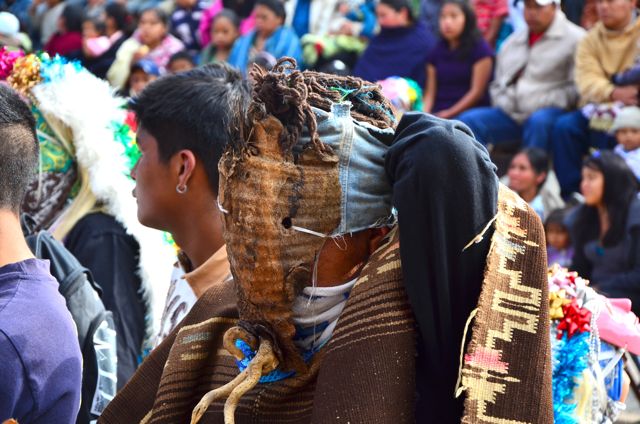
Having said all of that I want to describe an event we attended recently in which there was a competition of feo dancers.   So, the dance wasn’t directly connected to a another more serious dance although at the same event there was a competition of Kurpites dancers, a dance which is indeed serious and beautiful.   I was not sure quite what to expect but to our surprise there were only one or two masks of the rubber-monster type.   The remaining 30 masks were hand made, which is not unusual, but were made of the products of their immediate environment.  The pueblo is located in a stunningly beautiful area of mountains and thick forest.  The masks were made of wasp nest, wood, bark, maguey, deer’s head, sheep’s head and more.   One dancer carried a 5-6 foot snake (recently alive) and another carried a stuffed owl holding a squirrel.

The dancer with his head down is carrying a 6' snake.
This mask is made of a section of maguey.


Now,  the punch line.  Our informant told us that the feos danced to bring on rain.   If by the middle of May there was no sign of rain, the feos would be called up.   Rain dances are not uncommon in Mexico and usually take place around Easter or in May.  I am not sure how the dance is too change the minds of the gods and let the rain appear.  Do the masks scare the gods?  Do the masks enthrall the gods so the rain can sneak by them?   Are the gods pleased by the dance and thus return the pleasure in the form of rain?   It turns out the process is similar to asking a favour of the Virgin of Guadalupe; the dance itself is a form of petition.  One can see why the indigenous peoples took so readily to the new European religion.   What we saw was a competition of dancers but the real dance of the feos would be danced during the night


Monday, December 5, 2011

IDOLATRY OR DEMOCRACY

Apologies to Max Harris for overusing his 2003 book titled Carnival.  Several of the essays contained there have given me guidance in understanding my experiences.   But, please read Harris for yourself.

Pilgrims returning multiple images of the black Jesus which have visited the original black Jesus in another town.  My understanding is these images will rotate among the homes of the more faithful of the pueblo.   The dancers on either side are Arqueros (a version of the Matachines).
Not being Catholic I have always been struck by the number of religious images in Mexico.  As a protestant I was raised with the beliefs that follow from this bible quotation: Thou shalt not make unto thee any graven images.  (Ex. 20:4)   There is a great deal of debate even within Protestantism as to the meaning of this, but for Catholics God appears to be everywhere so can certainly be in a man-made object.  It is quite common to see a representation of a saint or of the Virgin being paraded through the streets and when you enter the homes of the working poor or the rural poor you might become aware of  the absence of what we might call “art”.  Instead the walls are often bare or if there is anything hanging there it might be a religious calendar, a mass produced image of a saint or the Virgin or something handed out at a religious festival.  I recently picked up a book-mark sized image of Pope John  Paul II when his relics passed through Patzcuaro.   I picked up a playing card sized image of Don Vasco on one of the few days his mausoleum was open.  I was given an image of Guadalupe when I passed through the church on her “day” to be blessed.   On Palm Sunday most people purchase a palm and these have usually been worked into a stylized image of Jesus or the Virgin.  On one saints day I noted that people were given long-stemmed gladiolas.   You also almost always find a small alter in the home, usually with a simple religious image, some flowers, a candle or two and perhaps an object or two.  You also may find alters in the doctor’s office (perhaps an image of “Dr. Jesus” with a stethoscope around his neck); you know you are in good hands. 
One of many stalls selling religious  images. 


The central image in Mexico is that of the Virgin (and Queen) Guadalupe and the most powerful image is that of the Virgin that appeared on the tunic of Juan Diego, the first person (a poor, indigenous, rural farmer) to be visited by Guadalupe. (It is important to keep in mind that in this founding story it was an indigenous person who first saw Guadalupe and he was instructed to speak to the local priest.) This image of Guadalupe is centrally controlled (the image never leaves the wall of the Basilica in Mexico City); not by the indigenous people’s themselves, but  by the religious hierarchy, few if any of whom are indigenous.   The skeptical might argue that the story of Juan Diego and the tunic with its image were creations of the Mexican Creole (those Mexicans born in Mexico of Spanish parents) who wanted to attract the indigenous population to Catholicism.  It was a device to attract the attention of the indigenous peoples.  However, the image never had much importance for the Indigenous peoples until Miguel Hidalgo (himself a Creole and annoyed about his group’s exclusion from political power) used the image in the first revolutionary steps towards independence from Spain.  Since then the image has appeared everywhere, mugs, tea towels, t-shirts, playing cards, greeting cards, and on and on.  And, the story and its image have become widely loved by indigenous peoples.  In this sense the image was taken from the central church and at least symbolically off the walls of the Basilica and placed in every aspect of peoples lives.   As I write this post we are approaching the fiesta for Guadalupe and almost daily an image (sometimes quite elaborate and others a simple painted depiction) goes through the streets with a few people following and bearing witness to their faith before returning to a local church.  Harris puts it this way:

Power thus spreads from the single sacred image, controlled by clergy, to the many images that live daily with the folk.  Power is refracted and diffused; sacred space is decentralized.  If the more powerful control the image at the center of the sacred space, the less powerful multiply the image, extending power to the margins.

 He argues that the multiple representations of religious figures is an indication of the ways in which spiritual power is (infinitely) divisible and often taken into the hands of local people themselves.  Spiritual power may be central and controlled centrally but it can soon move out into the community, to people’s homes and even to their clothing.  It can do this without taking the image itself.  As we have seen in other posts, I can touch the image and thus take some spiritual power home with me.  In one church where they distributed gladiolas to pilgrims they often tied a stick to the flower in order to lift the flower high enough to make contact with the painting of a sacred image.   To conclude, we can return to where this post began.  The homes of the rural power may have no art in some sense of the word but they do have multiple very ordinary images that presumably are thought to have some power (and perhaps even some beauty).

In a separate essay (also in Carnival, 2003) Harris suggests that much of Western theology (and other aspects of society) is built on a belief in scarcity - you have to choose A or B - there is never enough to go around.   But he suggests, folk theology prefers to believe that you can choose A and B, that is spiritual power can be divided and divided.  God is indeed generous.  It was in reading these few simple lines that I came to really understand the importance of the concept of “folk”.   Folk music, folk art, folk theology ad folk medicine have in common that they have their origins outside of the standards, belies, values and so on of the central authorities (priests, art historians, medical schools, etc.).  In the same fashion Guadalupe (or Mary) of the centralized church can become Maringullia of the folk dance, Malinche, or Tonantzin (the female godess of the Mexica of central Mexico).

Postscript:  Just as I finished this post I was in the Basilica when a Pilgrimage arrived with their image of Salud (the more important image of Mary in this pueblo).  Followed by the brass band which filled the sacred space, the local Virgin (a copy so to speak) came face to face with the real Virgin (the older image that is), but only for a moment.   The copy was quickly ushered into a back room and out of sight of the original.  While images can multiply and perhaps sacred power be distributed, it appeared that it wasn’t quite correct to have the two images in the same space.
Postscript 2:  I was recently in a restaurant in Morelia  (bearing a religious name) where there were 100 or more images of religious figures and they were all standing on their heads.  That is they were all turned upside down.  Was this just marketing or was their a political message?