Showing posts with label masks. Show all posts

Wednesday, January 18, 2012

FEOS, OR THE UGLIES

The feos are also called the “chiles” and are costumed characters in many traditional fiestas which provide comic relief to the more serious aspects of the greater dance event.  For example, the pastorlea is a serious dance performed during the Christmas season.  Although the dance has become quite stylized it represents the shepherds trying to get to Bethlehem to see the new born baby Jesus.  Forces represented by devil characters are determined to block their way.  It is only with the help of the priest holding his cross and San Miguel with his sword that the devils are killed or transformed.   Once the serious business is finished the feos appear in unusual masks (these days there is great use of preformed rubber masks of monsters and so on) and interact with crowd to provide some comic relief.   In one pueblo which we visit often I believe the feos have morphed into a form of political theatre which is great fun for the audience.  At one event dancers were dressed as “Bush’s army” riding around in card-board cars.  They stopped to search people, always finding a weapon which they had just planted in the victim’s  pocket.
At another event all of the dancers are cross-dressed (men dressed as women as women seldom participate in the dances).   Again, they roam the streets providing entertainment but also clearly violating gender roles so that one can see that by violating the norms or customs they are indeed reinforcing them.  Don’t do what we are doing or people will laugh at you.    Here one might argue that the cross dressing is a statement about homosexuality or, if we think of it as aimed at the women,  an encouragement to stay within their roles.


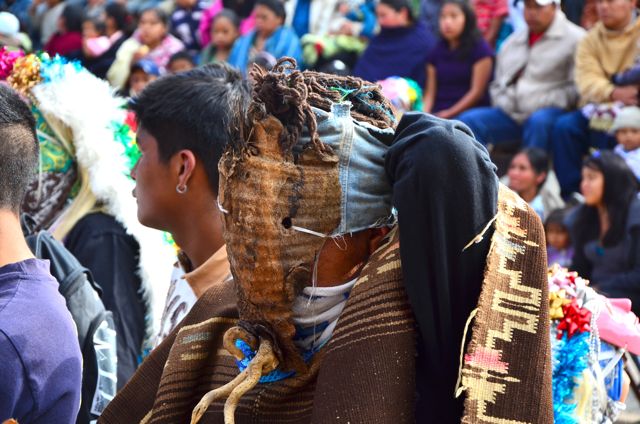
Having said all of that I want to describe an event we attended recently in which there was a competition of feo dancers.   So, the dance wasn’t directly connected to a another more serious dance although at the same event there was a competition of Kurpites dancers, a dance which is indeed serious and beautiful.   I was not sure quite what to expect but to our surprise there were only one or two masks of the rubber-monster type.   The remaining 30 masks were hand made, which is not unusual, but were made of the products of their immediate environment.  The pueblo is located in a stunningly beautiful area of mountains and thick forest.  The masks were made of wasp nest, wood, bark, maguey, deer’s head, sheep’s head and more.   One dancer carried a 5-6 foot snake (recently alive) and another carried a stuffed owl holding a squirrel.

The dancer with his head down is carrying a 6' snake.
This mask is made of a section of maguey.


Now,  the punch line.  Our informant told us that the feos danced to bring on rain.   If by the middle of May there was no sign of rain, the feos would be called up.   Rain dances are not uncommon in Mexico and usually take place around Easter or in May.  I am not sure how the dance is too change the minds of the gods and let the rain appear.  Do the masks scare the gods?  Do the masks enthrall the gods so the rain can sneak by them?   Are the gods pleased by the dance and thus return the pleasure in the form of rain?   It turns out the process is similar to asking a favour of the Virgin of Guadalupe; the dance itself is a form of petition.  One can see why the indigenous peoples took so readily to the new European religion.   What we saw was a competition of dancers but the real dance of the feos would be danced during the night


Wednesday, May 18, 2011

LA DANZA DEL TORITO


In previous posts I have described and commented on la danza Aztecs and la danza Matlachines, both of which I saw in San Miguel de Allende during the celebration of el dia de la conquista. The third dance performed that day was la danza del torito. I was not able to make any sense of this dance, thinking it must be a version of a carnival dance. Then I stumbled on a post from “mexicobob” which provides a description and explanation. Have a look at his post: mexicobob.

Photo: in the photo above you are able to see two of the three maranguillas performing that day (one of these may have been la borracha), el viejito (with the cane), el charo (the one with the little horse) and the devil with his whip. Other dancers, including the bull, were there but not in the photo.
The viejito

Perhaps this is the rancher

El toro and one of the Maranguillas.


Bob’s description of this event makes sense to me except for the role of the bull. Having read Max Harris I have begun to look for “hidden transcripts” and considering that the dance took place during the celebration of the conquest, I wondered if the bull in fact wasn’t a representation of the Spanish (the invader or the foreign). Is the message: they too will pass and we will remain? But, it the dance was first performed in 1830 and the primary character is a hacienda owner we are talking about those of pure Spanish blood but born in Mexico (Criollos), the group which began the first revolution and in spite of the significant role of Morelos (the indigenous military leader who first talked about independence and equality) came to own the land and dominate politics. Further, if the dance began in 1830 I am quite sure it was a creation of an indigenous group (rather than mestizos) and it would have a message. Is the dance then a show of resistance to this group? If we follow the logic of Harris, very few dances are just entertainment, there is frequently a hidden message. Could it be as simple as: the Spanish - or the Criollos - are caught between evil and death. But evil didn’t win out during the dance so we are left with death being the victor. The indigenous peoples are represented by the “apache” (I have not seen this dancer in two viewings) but since he is also defeated this does not appear to be a dance of resistance. Or, is it a more obvious dance of resistance with the toro representing the indigenous people who will only be defeated by death?
This is "el Moco"


I am open to suggestions on how to interpret this dance.

Monday, March 15, 2010

LOS NEGRITOS, OR THE BLACK DANCERS


I have already talked a little about the dance of the negritos and the importance of the negrito in the Purépecha culture. Now I am going to describe the negritos of San Lorenzo. This dance is described in some depth by Essler (1988) and you might want to read that as well.
The dance occurs on January 1 and is primarily about the transfer of care of the image of baby Jesus to a new carguero. The cargueros not only care for the image but they must organize the dance and transfer responsibility in the next year. For this reason it is perhaps the biggest event in the community and being associated with the image and the black dancers appears to bring status to community members. The dance itself is substantial with perhaps 50 male dancers with masks and costumes and a few women without masks but in fine clothing and hats of rancheras. The smallest contingent of dancers were the maranguillas ( who I believe represent Mary) wearing pink masks that were very feminine and included earrings and a few short ribbons hanging part way down their backs. They also wore bright skirts and wide brimmed hats with four artificial tulips standing on top. The next group of dancers continue to confuse me. Essler claims these dancers were viejitos but the masks were pink and very feminine, some had earrings and had finely embroidered aprons that looked a little like skirts and all if not most wore blond wigs. All wore cowboy boots and jeans and carried something which looked like a short whip. All had a few colourful ribbons attached to their heads which came a short ways down their back. Perhaps all of these dancers were maranguillas. There was one dancer who wore a mask that may have represented a viejito with a mustache but the mask gave no indication of old age. These two groups were the first to appear and performed a very typical two step and on occasion danced with members of the audience. This was clearly the preliminary act.

The negritos arrived to great fanfare. They wore beautiful black masks with flowers on top of their head and colorful ribbons hanging from the head almost to the ground. They wore traditional white pants and shirts. There were only five or six of these dancers and it was obvious that they were important from the crowd, almost entirely mature men, that pushed around them. These dancers made only a brief appearance in the courtyard before everyone took to the street to begin the procession through town. Although the negritos lead the procession they were not at first visible perhaps having withdrawn to a house until the procession arrived there. The other dancers were second in the procession followed by young women in beautiful traditional clothing carrying nine alters (four women to each alter) with images of the Virgin surrounded by flowers. These were followed by community members.

When the negritos appeared at the head of the procession it was clear they were honored, not only because one of them carried the baby Jesus but because they were in direct contact with the cargueros. The negritos carried a bottle of tequilla and a basket of sweets as gifts for the carguero. The negritos had linked arms with what I took to be the chief carguero as he carried a wand representing his authority (perhaps this was this the new carguero). Another carguero was always in front giving instructions on how to make the procession and the day the best possible (was this the old carguero?). To increase the number of negritos in the procession perhaps, two or three of the other dancers put on black masks in order to be close the cargueros.

Once the procession returned to the courtyard the negritos again were absent, arriving sometime later to great fanfare. As they had through out the procession the negritos clapped their hands rhythmically as if imitating a version of African rhythm. Upon entering , continuing to be surrounds by mature men, the negritos gathered in the centre of the yard where they appeared to have a contest of rapid dancing, usually in sets of two. On occasion the carguero would invite another dancer into the group but they donned a black mask before taking on the challenge of dancing with the negritos.

A wonderful introduction to the negritos in Purépecha culture but leaving a lot mystery as to what was really happening.

Sunday, January 31, 2010

SEEING COMMUNITY


Community! What is it? As a sociologist I have talked about community all my adult life having realized that sociology is a long nostalgic essay on the loss of community. If sociology is correct, most of us have never experienced community in the strongest sense of the term. We do see flashes of community in times of disaster or personal tragedies but what must it have been like in a stronger and or more encompassing form? First a word or two about this difficult notion of community. For me it refers to a strong sense of solidarity among a non-family group, a sense of belonging, involvement and emotional connection. The capacity and willingness of people to not necessarily deny their individuality but to be able to make substantial contributions to the common good or the welfare of the group. In most western societies this contribution is made in a very impersonal fashion - we pay our taxes and hope or even demand that government take care of the marginalized, the sick and the poor and even to organize our entertainment. Increasingly we rely on the corporate sector to arrange for public events, pay for what we call democracy and so on. Community would be a much more personal involvement and commitment to these projects.

This is a prelude to my trying to understand our experience of attending a Mexican fiesta on Three Kings Day (Jan. 6). We arrived in the pueblo, a place that is not really very remote now having good highway access, but felt like another world, around 3:00 pm. The town has a different feel to it because of being surrounded by forest and mountains and the more traditional type of housing. Not exactly the traditional trojes but troje-like. The town is an access point to the newest volcano in the world (having emerged in a farmer’s field around 1935 and exploded in the mid-1940s devastating a community), so attracts a number of tourist, many of whom are invited to travel to their destination on horse-back. The church was very attractive in it’s Christmas finery and the yard had a number of nacimientos (manger scenes) around the wall each with one or more doll sized images of baby Jesus. Local dancers were beginning to appear from houses and people were congregating in the large church yard. Before long there were too many dancers to count, a substantial crowd, three kings on horses and a beautiful image of the baby Jesus seated in a chair was brought from the church.

The dancers were unlike anything we had seen before but it became clear that they were “kurpites” (fittingly in the local language this means coming together). (However, some carried viejito canes adding to my confusion.) What was distinctive about the dancers clothing was that they had up to 20 aprons tied quite high up on the body and going around the body. This gave the dancers the appearance of being quite fat. These aprons were hand-made with fine needlework probably by mothers, aunts, grandmothers, girl friends. The dancers carried their personal history on their backs. These were the Kurpites dancers and as well one or two wore masks of Mary (Marangillas) and of Jose (Joseph). The dancers wore a scarf just over the nose and a mask covered in beads, tinsel and ribbons, on the top of their heads. Many appeared to have new cowboy boots and all had bells on their ankles. There appeared to be a group of quite young dancers (some 4 or 5 years old) and then a group of older teenagers. After much waiting the procession began with all of the dancers, the horses, an image of the Virgin, the image of baby Jesus and well as all of the Jesus figures from the mangers and a substantial crowd. An incense burner was carried before Jesus and immediately after one or two people throwing confetti on the carriers. The procession proceeded around the community on a very cold night accompanied by the usual cojetes (rocket-like fireworks).

On arrival at the church we found women appearing from the side streets with large containers of pozole, baskets of tortillas, more baskets of tamales and countless bags of oranges. Before long the church-yard was filled with perhaps 800 people (perhaps the whole town). The ritual of giving gifts to the children began. Remarkably they lined up without pushing or fighting and the young ones waited to be given a gift from one of the trucks parked in the yard. Girls appeared to receive small Barbie-like dolls, very small ironing boards, small plastic chairs and the boys very small plastic wheel-barrows and balls. Eventually the organization broke down as the men in the truck began throwing gifts into the crowd. There were no signs of “brought to you be corporation x” and no sign of political types.

In the background food was being prepared with a table set for the elders of the community and I assume everyone who wished would be given access to food. We too could have participated having been told that what was expected was presentation of a gift of cigarettes or tequila to the chief elder. Although we had purchased the gift we left the community before food was consumed having decided there just wasn’t enough space for 4 gringos to navigate the crowd.

For me a sense of community was every where but most clearly in the amount of effort and money many family had contributed to make this event happen and have the marvelous appearance and feel it did. For example, if there were 100 dancers (and there may have been more) each with 20 aprons, this would amount to 2000 aprons! Who purchased the gifts for about 200 young people? Who prepared all the food (this may have involved grinding the corn, making masa, filling tomales, etc.? In a traditional community like this there may have been a carguero in charge of the image of Santo Niño who may have been selected because of his resources and he may have borrowed money from others or required people to contribute money to purchase supplies, pay for the band, and so on. In any event what we saw was the signs of community with little presence of the usual stage managers of public events in the West.

One final thought: all of the dancers were under the age of 18 so this would create a constant need for new dancers thus bringing in the next generation. As a result the majority of the adults would share something in common with these kids. All of the males would be bound together in some fashion by this common service to baby Jesus and to the community. Females would be bound together in a similar fashion through their service to organization, costume creation and food preparation. I doubt if opting out of attendance was an option: saying you were tired or had other commitments just wouldn’t wash. Community came first.

Sunday, January 17, 2010

BLACK MEN OF SEVINA

an subsequent post (titled, Driving on New Years Day)) I mentioned learning that the “black men” were to dance on January 1 in the puebla of Sevina. On January 3 we returned to Sevina to see a concurso of dance happening in late afternoon. We had not seen the black men before, although we had seen them a previous year but only from from a distance so knew nothing of their masks. That year we had seen a number of dancers on the way to the home of a carguero, dressed in dark suits (what we now know to be “catrin” outfits, that is citifed clothing) but what were the masks? Were they negritios? This was my expectation. What a surprise when I walked up a hill to the carguero’s house this year having seen a crowd gathering and hearing band music. The dancers were all in their dark suits, but the masks! They were conquistadores. The masks of the conquerors of Mexico. These masks show a very pale skin, bright blue eyes and a substantial golden beard. Their hats were spectacular, looking somewhat like a traditional marching band hat but with flower decorations and many silver adornments. Later I was able to talk to the mask maker of this town and learned two things: first, the conquistadores were the ones who took baby Jesus from the manger in the church on December 26 and returned it to the carguero of the image. This job is reserved for the most honored dancers and in many communities this is the negrito. The history of the negrito in Tarascan communities is very interesting and well documented by Janet Esser (1988). So why were these black men not negritos? I am a little unclear of this, but the mask maker claimed that in the early days the mask maker either could not carve black masks or they were not very well done. His speciality was the mask of the conqueror and commonsense determined that this would be the mask used. Although very good negrito masks are now carved by the chief carver, the masks of the conquistadores are still the more honorable masks.

The dance competition began around 5:00 pm and while the conquistadores were present the centre of attention was on approximately 80 other dancers with a wide variety of masks, many of them of feos (or the uglies). These dancers came on throughout the night in small groups with the only rule seeming to be that no one could speak. They had to rely on their acting ability to try and get into the character of the mask. One came to appreciate the talent needed to really communicate, over a long period of time, the personality implied by the mask the person ws wearing. Towards the end of the evening there was more of a performance and participation in the judging from the rather large audience gathered around the basketball court and on adjoining rooftops.

Tuesday, March 10, 2009

HATS OF THE HERMITS


While attending a pastorela dance in Michoacan I was struck by the tall pointy hats of many of the dancers. These dancers were called the hermits (ermitanos) and this hat is found in many pueblos while other hermits are characterized by a very European looking mask and on occasion by a peasant-like straw cape. The pastorela is usually performed over the Christmas season and is in essence a nativity play. The first description of such a play in Mexico is from 1586 although the performance can be dated back to the 12th century. While some of the roles appear to be similar to those dating back many years each community presents its own version and it is often difficult to see just how it relates to the nativity story. So what was the origin of the pointy hat?

I recalled my childhood days when the pointy hat was called a “dunce cap” and was associated with being stupid or misbehaving. This hat goes back to the 13th century Scottish philosopher John Duns Scotus whose ideas where very popular. Duns had his students wear a pointy hat because he believed this shape helped channel knowledge. As always happens, however, Dun’s ideas fell out of favour and the pointy hat became associated with being stupid or holding unorthodox religious ideas. We need to keep in mind that philosophy at that time was largely religious philosophy. So how does this get to Mexico?
These hermits of Ihuatzio show that not all hermits wear the pointy hat.


You may be familiar with an interesting painting by the Spanish artist Goya (1746-18280) of an ecclesiastical tribunal in which the accused wears a pointy hat. The Spanish Inquisition was introduced in 1478 and while controlled by the Catholic monarch was really a religious court aimed at maintaining Catholic orthodoxy. Spain at that time was a multi-religious society (Catholics, Jews and Muslims – and later Protestants). The Muslims were defeated in 1492 and were converting to Christianity in order to attain access to the benefits of the wider society. Jews had begun to do the same after the terrible pogroms of the last part of the 14th century. However, there was growing concern that many of these were false conversions and that in fact many were secretly practicing their previous religion. A great majority of the accused during the first 200 hundred years of the inquisition were indeed Muslims. Other offences that came to the tribunal were sexual offenses and misbehavior by priests, particularly if they were espousing unorthodox beliefs.
Here the hats are very very pointy - Santa Fe de la Languna.

The inquisition was introduced to Mexico in 1570 so we can now guess a little as to what happened. Perhaps a priest was involved in sexual misbehaviour or announced unorthodox beliefs and his punishment involved something more than acquittal and less than burning at the stake. His public humiliation led him to withdraw from the society and as a result become a little crazy. His role in the pastorela is in part comic but also a symbol of someone who gave way to temptation. Thus, like the devils and the drunkards he is to be tamed by the presence of the church.

There is a remaining mystery. In the dance depicted in the above photo all of the hats had a number on them. I was unable to imagine that this was a personal identification or a hat size, so now I wonder if it was just a random number representing the number of the accused in the ecclesiastical tribunal. Does any one have knowledge of this?

Wednesday, February 18, 2009

TRADITIONAL DANCE AS A STUDY IN CONTRASTS


Having visited Tzintzuntzan for the fiesta del Senor Rescate at least three times I was excited to discover Brandes’ book of 1988 on fiestas and social control in Mexico. He has done field work in Tzintzuntzan for many years and this pueblo was the focus of his analysis. What had previously seemed like a Pastorela gone bad now began to make some sense to me. So a few weeks ago I returned to the pueblo to watch La Danza to see if I could find the elements he described or to see what might have changed over 30 years.

The dance was revived in 1974 and the work by Brandes comes from observations in 1977 so much may have changed. It does have some of the elements of the Pastorlea common throughout the state but there are elements that make it unique to Tzintzuntzan. There are about 100 dancers with a few specific roles. There are two to three angels all played by young girls, about 60 cristianos who dress in long white dresses, wear a long red cape with religious symbols embroidered on them. Four of these dancers are leaders who appear at the heads of the lines and have slightly differently costumes. Brandes reported that two were women and two were men but on this occasion they were all women distinguished by a high collar trimmed in fur on their capes. Then there are at least two devils who may or not be in red and at least two death figures. Finally there are an unlimited number of others in black capes and wearing monster masks. Have no fear however as the monsters and devils usually have religious symbols on their backs as well. All of this is consistent with Brandes.

The cristianos begin the dances by moving in quite well organized lines, at times going in circles and then doubling back, sometimes holding hands as they move down the centre of the field and other times appearing to weave in and out of their own lines. Brandes explains that they also make lines to form a cross and at other times weave to illustrate the symbol of the snake (a representation of evil). This part was not obvious to me but the field was so crowded, and much dust was rising, that it may have just been impossible to recognize the patterns. While this is going on the “others” danced in a very disorganized fashion around the outside of the lines formed by the cristianos and at times getting in their way. There appeared to be little interaction with the organized lines but they did interact with the audience. The younger dancers would occasionally grab a young member of the audience and try to pull them into the group or they would push a snake in their face or offer them something that looked like an attractive gift but was dangerous. Frequently these dancers would then briefly remove their mask to reveal their identity to a friend. All of the non-humans avoided human speech and only expressed themselves in shrieks. What I did not see, but which Brandes makes much of, were examples of rude behavour or even of forbidden behaviours. There were no signs of homosexual gestures or gestures of sexual intercourse. No intimations of toilet behaviour or of using their swords or scythes as symbols of the phallus. The other significant difference was that all the masks were now made of plastic while in the past the majority had been of wood.

In spite of these missing elements one could see indications of ways in which the dance reinforced cultural ideals and displayed what could be seen as the ideal behaviour. The ideal dancers for example, were organized and danced in a coordinated way while the others danced in a chaotic fashion. All of the devils, death figures and the monsters were men which says a great deal about expectations. The fact that the “troublemakers” are all boys and men may say to boys and men that the society understands their true nature but also informs them that this day is the only time this behaviour will be tolerated. It also shows that the things people fear the most – death, evil and aggression can be looked at squarely and laughed at for one day at least.

In all, however, one can see a dance of contrast: Christians and non-Christians, humans and non-human, order and disorder, culture and nature, light and dark. All of this is given religious approval on the previous night when all of the dancers walk in procession with people of the town carrying their religious image (here call the “coronitas” ) through the street and enter the church for mass before performing the dance for the first time during the fiesta.

One thing I did notice which seemed to challenge the underlying assumptions was that at least one of the cristianos, who are supposed to be unmarried women and men, was carrying her baby. Another young women had a stud in her lower lip, a sign of a wider culture creeping into the pueblo.

If you want to see more photos from this and other dances go to: flickr.com/photos/okeover

Sunday, February 1, 2009

LIKE HOCKEY FOR DANCING


Two weeks ago we traveled to San Juan Nuevo in Michoacan to witness the competition of the famous traditional dance of that town - the dance of the Kurpites, a dance dating back 300-400 years. As I watched the event unfold I began to think that the experience was similar to watching a hockey game in Canada. Let me illustrate. We arrived to discover that a stage had been erected in the town plaza and temporary viewing stands built on all 4 sides. The place was crowded shortly after the beginning and by the arrival of the main event there were at least 1.000 people present. The main event was a competition between two neighorhood teams, each team with about 12 dancers. The dance has clearly defined roles: Maria, a beautiful woman (perhaps representing Mary or a grandmother), the grandfather (or perhaps Joseph) and ten young men (the Kurpites). All have wonderfully carved wooden masks and exquisite garments and all must be unmarried men. The outfit of the grandfather is the most beautiful with every inch covered in embroidery or sequins. The interpretation of the dance is unclear but in one way or another it seems to be about courtship or gaining approval to marry. Each of the Kurpites wears a beautiful handmade apron sewn by his girlfriend. Each team dances and then the two Marias dance, then the two grandfathers and finally a representative of the Kurpities. A winner is chosen and then more dancing ensues through the streets and back on the stage. So how does hockey come into this?

Many vendors move through the crowds and everyone is eating. More importantly the crowd comes equipped with noise makers and they cheer for their favorite team (or for their neighborhood). There is much applause and as the various dancers take to the stage they throw candies for the children. There is great excitement. Like hockey the dancers must practice a great deal to improve their foot work and body moves. Indeed my friend who had not seen this dance before had convinced himself that the Maria had hips and breasts and was unbelieving when told she was a man. Dancers are carefully nurtured in the community, for example the first act of the afternoon had been a dance of the Kurpites by young community members and their outfits were equally beautiful and the dancers polished. I am sure every house in Canada still has a hockey stick or two in the basement and maybe some tattered equipment. As the afternoon progressed I began to imagine that every house in San Juan Nuevo must have a mask or two, maybe an old apron or other dance items. The dance penetrates the town very deeply.
While there are similarities to hockey we see that the old dance has not been commercialized nor professionalized and the dancers dance for the status and not for money. But the dance gives the town pride through the skill of its community dancers and though the extensive involvement of the entire community. It is a source of identity and to some extent distinguishes this town from others.

While the community itself pays for much of this event there are other interesting sources of financial support I will try to talk about in a future post.

Thursday, January 29, 2009

TRADITIONAL DANCE OF AJUNO, MEXICO


Another day, another chase. My wife and I are interested in the traditional dances of Mexico so are constantly on the watch for information about dances. I recently saw that there was a dance to be performed in Ajuno but not knowing just what time of day it might occur it is always a gamble. We headed out around 2:00 pm and upon arrival determined that something was up: a small midway for children (mostly consisting of trampolines and a couple of traditional rides) was in operation, a basketball tournament was in progress and lots of people were around. However, there was already lots of garbage and confetti on the ground – maybe we had missed it. We learned that it was to happen shortly. Almost two hours later the dancers appeared and watched the basketball game until there was much church bell ringing and cujetes (these are a noisy firework that is shot high into the air where it explodes). Sure enough a small procession was forming: four women in front with church banners, four people carrying the local image of the Virgin ( small, beautiful image with what looked like long human hair - this probably is human hair as women will offer their hair to the virgin as a type of exvoto), a band, 20 dancers, a small number of pilgrims and then another band for good luck. The processions went to the first corner where the Virgin was set down at a dusty and rocky intersection and the dancers gathered in front of her and the priest.

This is a small town so the costumes were not elaborate but clearly it was the dance of the Moors (Moros): They wore hats covered with flowers which rose to a soft peak, large red capes adorned with crosses, the name of the virgin and mirrors. Their leggings were pinned to jeans and they had cowboy boots with spurs attached. There was also the traditional veil that almost entirely covered the face. These veils had images of Guadalupe on them or images of Juan Diego kneeling before Guadalupe. Two young men accompanying the Virgin carried large torches and many of the audience held long candles. The men in the audience had hats in hand.

The Virgin leaves the church and begins the procession through town.

The dance steps looked familiar but I could see no pattern and am not aware of the significance of the steps. The dance of the Moors is traditionally performed for the patron saint of the town, as was the case today, or it may be done to mark the defeat of the Moors by the Christians in which case the dancers tend to wear masks and there are clearly Moors to be defeated. The dance for the patron saint is probably built on a very old dance with religious elements attached after the Spanish conquest. I believe this dance is a depiction of the conversion of the Moors to Christianity and by implication, the indigenous peoples of Mexico as well. After about ten minutes of the dancers stepping systematically and clicking their heels, they all bowed before the Virgin. According to tradition, after the procession they group must at least go into the church, but not necessarily attend a mass.

Here we can see the Virgin watching the dance of the Moors.

The group then raised the Virgin and walked through the streets were more people were waiting and the dance was repeated.
Here we are on the other side of town and the procession stops to watch the dance of the Viejitos.