Showing posts with label Michoacan. Show all posts

Saturday, March 24, 2012

CARNIVAL AS MAKING COMMUNITY VISIBLE

If you are a regular reader of this blog you may rightly have concluded that I am obsessed with “community”.   You would be right since I believe I see community much more directly in Mexico than I do in Canada.  Now you may well say, “here he goes again”.

We recently attended a carnival event in a small pueblo, an almost immediately I said, “now this is community”.  Quite different than the block parties I am accustomed to.   The event began with many members of the community gathering in the centre of town and then forming a parade of sorts with the mandatory band keeping everyone on track and bottle rockets telling everyone else to get a move on or they would miss the festivities.   At the head of the parade was a burro, nicely adorned with ribbons and balloons and more importantly, carrying the beer.  The destination was a dusty and rocky intersection about 500 meters from the pueblo.
The men unload the beer.


At this intersection a small slice of community life was enacted.   Women had brought food, tables were set up and those who wished could sit down to eat.  Since carnival in this region is often about cross-dressing there were a number of men in tight dresses, pantyhose and high heels.   Two or three of the men wore masks.  The women too assumed roles of men although they didn’t really cross-dress.  Instead they carried hand-carved wooden swords whose symbolism said -”we are men”.  Other women acted like the male cargueros of other events in that they wore cowboy hats, had the essential woven bag over their shoulders and carried and distributed the tequila to all assembled.   Aside from eating the main event was dancing.   The male-women went into the crowd and brought other men to the dance floor, young women did the same and it was in this way that we were invited to the dance “floor”.   My partner was a young woman who had flown home from Los Angles just for this event.   The old women stood together in their dark clothes, with colourful confetti in their hair, rarely smiling and talking quietly among themselves.  There were very few old men. 
Did I mention that the dresses are tight.

Here we see the women with their swords.


After an hour of dancing the group returned to the pueblo, gathering in the basketball court where the local farmers had arrived with wheelbarrows full of fruit and vegetables which they distribute to the crowd.  Everyone then went home for a while before reassembling for a dance which went on late into the night.   If the men became too drunk the women, perhaps the ones with the swords, were entitled to lock them up for the night.


So, we saw elements of many Michoacán carnival events - the torito and cross-dressed men taunting the bull and then forcing men to dance with them.  But, more importantly for me, we saw all of this performed in a community setting.  All were linked together through some connection to this little place, all categories of the community were present and a strong sense of making things happen for their own entertainment and fulfillment of traditional responsibilities.

Sunday, March 11, 2012

SAN ANTONIO


This post began with a visit to a restaurant in Morelia to celebrate a friends 70th birthday. She wanted a “funky” restaurant and the San Miguelito of Morelia was recommended by locals.  We knew nothing about San Miguelito but having hired a driver and worked our way through two road blocks - one at the Governor’s house and the other just short of the restaurant - we entered a large establishment with 3-4 sitting areas and lots of interesting “stuff” on the walls.  The first room (The Altar of Conversations) was for families with appropriate decor,  the second for business lunches (La sala de conspiracion) and the third where we were seated was called Rincón de las Solteronas (the corner for single women).  This was an amazing room, every inch being covered with images and photos which we immediately realized were religious images, about 250 in total.   But, they were all standing on their heads (boca de abajo).   The image to the side of our table was a life-sized San Antonio, of course on his head.   We gathered from the signs that this room was where one might find a partner.  It didn’t look like  singles bar.  So, what was this all about  - a religious parody?   Was the owner anti-Christian?

No!   The answer is much more interesting.   San Antonio is the saint of singles and he can be approached in the search for a mate.  While not very common today young women (San Antonio is not sexist, but the culture is) can take a small image of San Antonio to church, light 13 candles and while holding the saint on his head, make a petition for a mate.   In the restaurant singles where to take 13 one peso coins and walk around the large image 13 times and on each rotation put a peso in the hand of the saint.  Then, one writes your petition in a book at the side table.  If your petition is answered you are entitled to return to the restaurant and turn one of the images right-side-up.   We could not find one standing upright!

Wednesday, January 18, 2012

FEOS, OR THE UGLIES

The feos are also called the “chiles” and are costumed characters in many traditional fiestas which provide comic relief to the more serious aspects of the greater dance event.  For example, the pastorlea is a serious dance performed during the Christmas season.  Although the dance has become quite stylized it represents the shepherds trying to get to Bethlehem to see the new born baby Jesus.  Forces represented by devil characters are determined to block their way.  It is only with the help of the priest holding his cross and San Miguel with his sword that the devils are killed or transformed.   Once the serious business is finished the feos appear in unusual masks (these days there is great use of preformed rubber masks of monsters and so on) and interact with crowd to provide some comic relief.   In one pueblo which we visit often I believe the feos have morphed into a form of political theatre which is great fun for the audience.  At one event dancers were dressed as “Bush’s army” riding around in card-board cars.  They stopped to search people, always finding a weapon which they had just planted in the victim’s  pocket.
At another event all of the dancers are cross-dressed (men dressed as women as women seldom participate in the dances).   Again, they roam the streets providing entertainment but also clearly violating gender roles so that one can see that by violating the norms or customs they are indeed reinforcing them.  Don’t do what we are doing or people will laugh at you.    Here one might argue that the cross dressing is a statement about homosexuality or, if we think of it as aimed at the women,  an encouragement to stay within their roles.


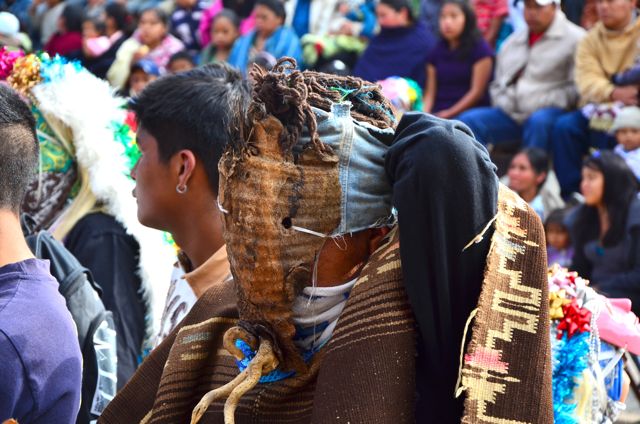
Having said all of that I want to describe an event we attended recently in which there was a competition of feo dancers.   So, the dance wasn’t directly connected to a another more serious dance although at the same event there was a competition of Kurpites dancers, a dance which is indeed serious and beautiful.   I was not sure quite what to expect but to our surprise there were only one or two masks of the rubber-monster type.   The remaining 30 masks were hand made, which is not unusual, but were made of the products of their immediate environment.  The pueblo is located in a stunningly beautiful area of mountains and thick forest.  The masks were made of wasp nest, wood, bark, maguey, deer’s head, sheep’s head and more.   One dancer carried a 5-6 foot snake (recently alive) and another carried a stuffed owl holding a squirrel.

The dancer with his head down is carrying a 6' snake.
This mask is made of a section of maguey.


Now,  the punch line.  Our informant told us that the feos danced to bring on rain.   If by the middle of May there was no sign of rain, the feos would be called up.   Rain dances are not uncommon in Mexico and usually take place around Easter or in May.  I am not sure how the dance is too change the minds of the gods and let the rain appear.  Do the masks scare the gods?  Do the masks enthrall the gods so the rain can sneak by them?   Are the gods pleased by the dance and thus return the pleasure in the form of rain?   It turns out the process is similar to asking a favour of the Virgin of Guadalupe; the dance itself is a form of petition.  One can see why the indigenous peoples took so readily to the new European religion.   What we saw was a competition of dancers but the real dance of the feos would be danced during the night


Tuesday, May 3, 2011

KIDS MATTER


I have talked about children a lot in these post but I return to it again for a more focused look. We often here the expression that “it takes a village to raise a child”. This expression seems to have multiple meanings depending on the speaker or the audience. It might mean better education, more program support for parents, fewer punitive responses from the community or more acceptance of children in housing and on the streets. Let’s look again at a few events which I believe show how the community here participates in raising children.
I describe again the feature of the day of the revolution parade that impress me. The celebration takes place on November 20, but the week before the preschool children dress in their revolutionary costumes and take to the streets in a parade. There are quite a number of children in rural Mexico but the community waits patiently while the parade blocks streets and parents and friends throw confetti on the children. This year they were accompanied by an adult marching band. Then on November 20 the older children, as well as a few adults like the mayor, the queen for the day, and men on horses form a parade that takes about 90 minutes to pass. The majority of the towns traffic is brought to a standstill. The young people have their own school bands and it is clear that everyone is taken seriously; they are centre stage for the day and much of the community participates with cheering and confetti. Young people learn their history (some being dressed as revolutionary heros and other carrying images), a great deal of time is spent in preparing (learning how to march around corners) and they are seen as important in the eyes of the community.
Surprisingly this whole thing is repeated for the first day of spring when the preschool children hold a parade through the centre of town in their birds and bees costumes. But in a very general sense we find that children are not excluded from events. They spend the night in the cemeteries with their parents and grandparents, they are taken to restaurants, they walk on the streets (there being very few strollers), they help their parents in stores and stalls from a very early age and they appear to be part of the community in ways seldom seen in other parts of North America (except perhaps among immigrant families).
During the biggest religious festival of the year I was struck by the clarity of this belongingness and the inclusion of children. Two images: first, in the Basilica many families chose to crawl on their knees up the aisle to the alter (thus fulfilling a promise). Parents and children did this together. At times the children would turn the crawl into a competition but they were never scolded or restrained. One parent chose this occasion to provide her daughter with another lesson in crossing herself properly. All of this in a standing crowd of 600-700 people. Second, during a religious procession (the entire event had gone on 16 hours) one of the mothers playing an important role throughout the day, was carrying a young child who was sound asleep. This while following the most important image of the community and also the bishop who had come to town to assist in the celebrations.

In this community I have seldom heard children crying, being shouted at, being treated roughly or throwing a tantrum. If you do see any of these behaviours it is invariably a family from the big city. Children appear happy, alive, confident of who they are and fully participating in the life of the community. One can not help but be struck by the absence of a strong youth culture in this semi-rural community. Everyone listens to the same music, the only difference being individual preference not age. By the age of 2 years, children know exactly how to move their body and feet to the music.
We attended a concert of a local, and somewhat famous, group a few nights ago and the theatre appeared half full of children, none of whom were quiet. I heard no one complain nor did I hear children being scolded. (Although we did move seats because the kids behind us were talking and hitting the seat.) I decided at that moment that here was the answer to why the volume is always very loud at Mexican events.
Some of these same children of course put graffiti on our walls on the way home from school. I am also not naive enough to believe that all is sweetness. Many children are abandoned by families too poor to care from them or have limited parenting skills or no extended family. One little boy we have watched for a few years is not allowed to get back into the house without a specified sum of money. He literally sings for his supper. There are probably the same numbers of abused children and mothers, the same numbers of family breakdowns and so on as you would find in other parts of North America. But something is clearly different as well.

Thursday, January 27, 2011

THREE STRANGE KINGS


This year we went to Ihuatzio, a small town only a few kilometers from Patzcuaro, on January 6 which is Three Kings day. We arrived in the middle of things so were unable to get a real sense of the events of the day but here are some notes on what we have learned.
There appeared to have been a pastorela dance which is common during the Christmas season. Some of the dancers were entering homes which quickly became overcrowded . The centre of attention was on a group of about 7 men who wore unusual outfits: they wore fedora hats (a European style hat) and long summer overcoats (abrigos or gabardinas). I thought these men must be the cargueros of the village or of the dance but I later discovered they represented the Three Kings. Would like to know where this tradition came from. The men were called capoteros (derived from the word for cape). The Kings immediately linked arms and began moving quickly in all four directions, creating the threat of one of them falling over or of members of the crowded being knocked over. Would like to know what this represented. This lasted only a few minutes with great laughter and then they sat down and food was brought to them while a group of female dancers (guarecitas) performed. After 15 minutes the action moved on.
At the next stop we were offered a plate of food by one of the Kings. It contained a bowl of fava beans coved with sugar and the whole bowl covered with a very large tortilla. We later learned that the gift was a sweet gift typical of the season. The large tortilla was really a buenjelo (usually a very sweet flat bread which is deep fried rather than quickly cooked on a comal). We were expected to make a taco of the material but few if any people appeared to do this. (Perhaps this was their 4th or 5th offering).
We saw two other groups of dancers. First, a rowdy group of feos (usually cross-dressed) and second large group of young boys (perhaps 40) in pink to red smocks with hoods. These boys represented the hermits which again are common to the pastorela dance.
More about this event next year.

Monday, January 24, 2011

JANUARY 1 CIRCUMCISION


For two years we have gone to Purepecha villages to witness celebration and dancing. One might think this is just a celebration of the New Year but for the Purepecha the new year begins on February 1, their calendar being set by the motions of Orion. Also, there are often images of Santo Niño on this day. This is perhaps understandable since the day is close to Christmas but it doesn’t really make sense.
A little research uncovered two things that might makemore sense of the celebrations on this day. First, according to Jewish tradition baby boys are circumcised 8 days after birth. If you count December 25, this means Jesus was circumcised on Jan. 1. So what is the deal? Catholics were encouraged to see this circumcision in a non-Jewish framework so saw this drawing of blood as the first indication of the crucifixion and the blood shed to save each of us. In addition, this day was when Jesus would have received his name - the first day he was called Jesus. Until 1960 this day was part of the Catholic calendar but has been removed and replaced with another celebration. The indigenous peoples of Mexico, however, may have hung on to this earlier tradition as it had become linked to fiestas and dances.

Or, here is another take: I have been reading further writings of Max Harris on the “feast of Fools”, a much misunderstood festival present in the medieval Catholic church and silenced by later religious authorities. The event was part of a sequence of nativity festivals and occurred on December 28 (the festival of innocents, what we are now told is similar to April fools day). This festival involved an element of revelry and practices which can easily be misinterpreted as pagan or inappropriate. For example, the ass was welcomed into the church, there was cross-dressing even among the clergy, the lower clergy played the parts of the higher clergy, and so on. Harris reinterprets these events within a religious (rather than pagan) framework and begins with the observation that all religious drama should be seen as having the intent of making the invisible incarnate. Complex theological narratives were made clear through theater, drama, and performance and the feast of fools was just another of these dramas. He then reminds us of one of the most peculiar aspects of the Christian narrative - Jesus was born in a manger among the animals and his mother was carried to her delivery by an ass. Further, the first to be told of the birth were the shepherds and the animal world. In short, Christianity is presented as beginning with the lowly and the humble and not the kings or religious authorities. The feast of fools appears to celebrate this aspect of the Christian narrative. Finally, the bible tells us that the world will be turned upside down - the lowly shall inherit the earth, etc. This is what we see in the cross-dressing and the lower clergy acting above their station and so on - things are turned upside down.

Now, although this festival was discontinued 500 years ago and it is not clear from Harris if the festival also occurred in Spain, one does wonder if the festival in Michoacan on January 1 are remnants of this festival of fools. The cross dressing on January 1, for example, would make sense in this context.

Wednesday, December 15, 2010

EATING WITH THE DEAD


This year we were invited by a Mexican Catholic family to share a meal with them at the grave site of family members. This was a small cemetery in rural Mexico, approachable only by a quite rough road and many of the graves were set among the trees. About 25 friends and family gathered for a meal of mole con pollo, corundas and the usual round of tequila.

I was struck by the antiquity of this Christian tradition. Before the birth of Christ the dominant belief among Romans and Greeks was that the corpse was defiled and to be avoided, thus burials were handled by “experts” and took place at some distance from the community. However, it was not unusual for family members to make the trek to the grave site and to share a picnic. After the death of Christ it became more common for people to gather and eat with the dead. Approximately 1000 years ago the Pope decreed that the spirits of the dead returned to earth on November 2, beginning at 12:01AM on the morning of the second. It is for this reason that Mexicans and many others spend the night in the grave yard and decorate their homes in order to help those spirits find their way home and to make them comfortable. In a few communities this tradition is carried on during the day rather than at night. Graves are cleaned and decorated to various degrees and families gather to eat with the dead. For some reason North America has transformed this day into an event that is supposed to frightening with witches and goblins. How did that happen?

During our meal with the dead there was no reference to the dead and in fact we sat slightly away from the grave to avoid the heat of the sun. However, the belief is that the dead are indeed at the scene, so are with you. You are eating with the dead. However, I did not see a plate set for the spirit. (However, many graves to do have food set out for the spirits.)

There is of course vast cultural differences among the peoples of the world in terms of their treatment of the dead. As noted some build cemeteries at some distance from the town (towns often sprawl so that they became more central) while others place them in the very centre of the village housing In yet others the bones of the dead are buried under the bed of the survivor. In the early Christian church it was traditional to build the church over the grave of a saint, preferably putting the alter directly above. In quite old churches it is common to find significant community members buried under the church floor and if possible to have the bones of the venerated within the church itself.

This seems related to the literal or symbolic act of eating the dead. Sharing the body of Christ during communion or actually eating the dead to retain the sacred quality of that person. Not too different than hunters an gatherers who placed great value on eating the heart or the eyes of an animal. These parts were believed to transfer powers to the hunter and to others. In Canada the head of state, while visiting Inuit peoples in the north, was offered a portion of the warm heart of a seal. She ate it as though accustomed to the act and created much conversation. What was intended as a spiritual act became a political act. Was she supporting the rights of the Inuit to hunt seals and sell their furs?

(NOTE: the references to history come from Margaret Visser, The Geometry of Love.)

Wednesday, November 24, 2010

LISTEN UP CANADIANS!


Hockey is important to Canadians, although the real national sport is lacross which predates hockey by many years having been played by indigenous peoples of the region. But, you only get hockey night in Canada and there is endless chatter in the media about teams and playoffs. When the Olympics come around Canada's pride and sense of identity is carried by the hockey team. But a form of hockey can be found at least 3500 years ago in Mexico, the center of this game being Michoacan.
Archeological artifacts from the above date show small clay sculptures of figures carrying what are clearly hockey sticks. This game is still practiced today and is undergoing a resurgence among the local indigenous community (Purepechas) and the non-indigenous. Traditionally, there were 5 people per side, the sticks made of a single piece of wood with a curve created by the growth of a branch. The sticks may be decorated and are quite heavy. The ball (our puck) can weigh no more than 500 grams (just over one pound) and is made of a stone covered in a foam-like material and then this is covered with a woven material (perhaps originally from cactus fibre) applied in such a way as to not allow the adherence of water. This ball is then soaked in gasoline and set afire. The ball can be hit with a very strong blow, sending it flying throw the air with the opposition only able to stop it with their sticks. There are frequent injuries to the players and almost always a little tension to the game as the ball may strike the clothing of an observer, go under a nearby car or land on a plastic tarp of neighboring food stalls.
The game appears to be very competitive but in fact it is pure ritual. Perhaps the equivalent of Canadians singing the national anthem prior to a hockey game, a shaman-like person opens the game with the playing of a conche shell, the recitation of verses giving thanks for the air, water, land etc. and then turning to the four directions. While this goes on the players have placed their sticks in a pattern around the ball. At the close of this ceremony they kneel to touch the earth. The purpose of this ritual in unclear but there is clearly an exotic and mysterious feel in the air. Perhaps the significance is carried in the fire ball. The new year for the local indigenous people is February 1 and the new year is ushered in with a ceremony of the new fire. The fire ball must have some connection to the importance of fire in this ritual.

Friday, May 7, 2010

VISIT TO 7 CHURCHES, HOLY THURSDAY

For the non-Catholic there are many events surrounding Easter that seem mysterious in the sense of being unfathomable at first. One of these is the practice of visiting seven churches during the evening of holy Thursday (Maundy Thursday). Why 7 churches? What are you to do while in the church? In Pátzcuaro it is very easy to visit 7 churches in a reasonable time as you can find them within about a 5 minute walk of each other. As a result, come 7 PM, the whole town appears to be on the move giving a friendly neighborhood atmosphere. The streets are a gentle flow of people going in all directions, often making vehicle traffic difficult. There are one or two food stalls outside each church but the focus appears to be on family gatherings, talking as they approach the next church. So many people are engaged that there are lines at each church and you are usually funneled in and out quite quickly. In many, the majority of the pews have been removed to give room to move and stand for a few minutes, but some people do manage to get to the remaining pews and appear to sit for awhile. We managed to enter two churches before deciding the lines too long. On returning from diner around 10:00 PM there were still substantial lines, so I have no idea when the flow eased. OK, what is this about?

The term Maundy appears to come from the Latin word at the base of the Spanish term “mandar”, meaning to command or order. Now we need to remember that Thursday was the day of the Last Supper and at this event Jesus is thought to have said: “Love one another, as I have loved you”. So the whole evening is a commemoration of the Last Supper. Although practice may vary from place to place, earlier in the day there may have been a Last Supper mass where the sacraments (the bread and wine) were used. After that mass the sacraments are removed and placed in the “alter of repose”, which may well be just a cabinet. (At this mass there may also be a blessing of the oil which will be used in religious events throughout the year and as many priests as possible are encouraged to attend to symbolize the disciples of Jesus). There will not be another mass until the day of resurrection.

So when one visits the 7 churches you are thought to be doing a number of things. Commemorating the Last Supper, but perhaps more importantly spending time with the “alter of repose” which I think now stands for Jesus. Perhaps we are declaring that we are disciples of Jesus. So we are sharing time with each other and also with Jesus prior to the dreadful events of the Friday to come. In previous centuries, and even today, these visits were also a way to obtain an “Indulgence”, which is a payment for the debt one owes to God. For this to count one must spend one hour in devotion to God and take communion earlier in the day or within the next week. This might help explain why so many participate in the activities of Holy Thursday.

So why 7 churches? This is unclear to me but in the book of revelations there are 7 churches mentioned which are now located in Turkey. These churches date from the first century and were a significant part of Christian history. Each of these carries a distinctive personality characteristics, also thought to be characteristics of people. For example, there is the church that falls asleep, the church that is neither hot nor cold, the church of brotherly love and so on. There are now 7 churches in Rome, identified by Papal order, to be the 7 that followers should visit. So in every city and town the 7 churches you visit must stand for those churches of the pilgrim route. If well informed each church gives you a moment to reflect on the features of your own personality.

As a non-Catholic I find it very hard to understand the conceptual language of Catholicism so it is very possible I have this story very wrong.

Thursday, March 18, 2010

FRAGMENTS: PILGRIMS, DOCTORS

#4 Continuing with my some time theme of fragments, a brief comment on pilgrimages.These are common the world over and watching religious pilgrimages I am struck by how common it is for people to entertain long walks. One walk close to where I live covers a distance of perhaps 15 kilometers where the pilgrims must walk in the ditch at the side of the road. Nevertheless, hundreds of very ordinary people do this , sometimes in family groups or with friends. Some parents carry children on their shoulders or even push strollers (although these are very uncommon). They take on this duty early in the morning or after work. Some are enticed I am sure by the fiesta which is present in the town for pilgrims and visitors alike. Sometimes there will be a special mass for the pilgrims - at one event the pilgrims travel on bicycles and at another on horseback. One very special pilgrimage covers about 72 kilometers and many do this over several days, often camping by the side of the road at days end. Other will take the bus part way and then walk the remaining distance. At another there is a fiesta for the returning pilgrims who bring back religious images which appear to be in some way related to, or blessed by, the more important image in the distant town.

What continue to strike me as interesting is that these feats are given no status because of their exercise value, no certificates are awarded on completion, no names appear in the newspaper. That is, walking is not given a physical significance, rather it is the journey that is given religious significance. In the west, feats of walking or running are only given physical value or sometimes a social value for representing groups we would normally think unable to perform these feats (survivors of cancers, the elderly, etc.) for drawing attention to these people in our regular lives.

#5 A visit to the doctor

A visit to our Mexican doctors leaves two immediate impressions. First, there is no bank of patient files behind the receptionist whose major task appears to be acting as gatekeeper, collecting money and watching the soap operas. There are no patient files because information is always the property of the patient and the doctors themselves keep computer files. In Canada she would be busy making appointments, tracking down lab reports, making arrangements with specialists, attending to the enormous bank of files, and so on. The other, is the presence of images of the baby Jesus. In this waiting area there are three images. The largest is of Jesus dressed in white, carrying a doctors bag and seated in a chair. In the other he is dressed in a blue dress like garment and carrying a small basket. The third is a photo of an image dressed in white and again carrying a very small doctor’s bag. In addition there is a very small image of Guadalupe set again he photo. In Canada one might well find a religious image but I would think it quite uncommon.

Once in the office again you find a very small image of the baby Jesus seated in a chair. It is placed beside a souvenir from Alaska and amongst family photos. Almost hidden to the back of a shelf is a small wooden crucifixion cross. You know you are in good hands!

Monday, March 15, 2010

LOS NEGRITOS, OR THE BLACK DANCERS


I have already talked a little about the dance of the negritos and the importance of the negrito in the Purépecha culture. Now I am going to describe the negritos of San Lorenzo. This dance is described in some depth by Essler (1988) and you might want to read that as well.
The dance occurs on January 1 and is primarily about the transfer of care of the image of baby Jesus to a new carguero. The cargueros not only care for the image but they must organize the dance and transfer responsibility in the next year. For this reason it is perhaps the biggest event in the community and being associated with the image and the black dancers appears to bring status to community members. The dance itself is substantial with perhaps 50 male dancers with masks and costumes and a few women without masks but in fine clothing and hats of rancheras. The smallest contingent of dancers were the maranguillas ( who I believe represent Mary) wearing pink masks that were very feminine and included earrings and a few short ribbons hanging part way down their backs. They also wore bright skirts and wide brimmed hats with four artificial tulips standing on top. The next group of dancers continue to confuse me. Essler claims these dancers were viejitos but the masks were pink and very feminine, some had earrings and had finely embroidered aprons that looked a little like skirts and all if not most wore blond wigs. All wore cowboy boots and jeans and carried something which looked like a short whip. All had a few colourful ribbons attached to their heads which came a short ways down their back. Perhaps all of these dancers were maranguillas. There was one dancer who wore a mask that may have represented a viejito with a mustache but the mask gave no indication of old age. These two groups were the first to appear and performed a very typical two step and on occasion danced with members of the audience. This was clearly the preliminary act.

The negritos arrived to great fanfare. They wore beautiful black masks with flowers on top of their head and colorful ribbons hanging from the head almost to the ground. They wore traditional white pants and shirts. There were only five or six of these dancers and it was obvious that they were important from the crowd, almost entirely mature men, that pushed around them. These dancers made only a brief appearance in the courtyard before everyone took to the street to begin the procession through town. Although the negritos lead the procession they were not at first visible perhaps having withdrawn to a house until the procession arrived there. The other dancers were second in the procession followed by young women in beautiful traditional clothing carrying nine alters (four women to each alter) with images of the Virgin surrounded by flowers. These were followed by community members.

When the negritos appeared at the head of the procession it was clear they were honored, not only because one of them carried the baby Jesus but because they were in direct contact with the cargueros. The negritos carried a bottle of tequilla and a basket of sweets as gifts for the carguero. The negritos had linked arms with what I took to be the chief carguero as he carried a wand representing his authority (perhaps this was this the new carguero). Another carguero was always in front giving instructions on how to make the procession and the day the best possible (was this the old carguero?). To increase the number of negritos in the procession perhaps, two or three of the other dancers put on black masks in order to be close the cargueros.

Once the procession returned to the courtyard the negritos again were absent, arriving sometime later to great fanfare. As they had through out the procession the negritos clapped their hands rhythmically as if imitating a version of African rhythm. Upon entering , continuing to be surrounds by mature men, the negritos gathered in the centre of the yard where they appeared to have a contest of rapid dancing, usually in sets of two. On occasion the carguero would invite another dancer into the group but they donned a black mask before taking on the challenge of dancing with the negritos.

A wonderful introduction to the negritos in Purépecha culture but leaving a lot mystery as to what was really happening.

Sunday, January 31, 2010

SEEING COMMUNITY


Community! What is it? As a sociologist I have talked about community all my adult life having realized that sociology is a long nostalgic essay on the loss of community. If sociology is correct, most of us have never experienced community in the strongest sense of the term. We do see flashes of community in times of disaster or personal tragedies but what must it have been like in a stronger and or more encompassing form? First a word or two about this difficult notion of community. For me it refers to a strong sense of solidarity among a non-family group, a sense of belonging, involvement and emotional connection. The capacity and willingness of people to not necessarily deny their individuality but to be able to make substantial contributions to the common good or the welfare of the group. In most western societies this contribution is made in a very impersonal fashion - we pay our taxes and hope or even demand that government take care of the marginalized, the sick and the poor and even to organize our entertainment. Increasingly we rely on the corporate sector to arrange for public events, pay for what we call democracy and so on. Community would be a much more personal involvement and commitment to these projects.

This is a prelude to my trying to understand our experience of attending a Mexican fiesta on Three Kings Day (Jan. 6). We arrived in the pueblo, a place that is not really very remote now having good highway access, but felt like another world, around 3:00 pm. The town has a different feel to it because of being surrounded by forest and mountains and the more traditional type of housing. Not exactly the traditional trojes but troje-like. The town is an access point to the newest volcano in the world (having emerged in a farmer’s field around 1935 and exploded in the mid-1940s devastating a community), so attracts a number of tourist, many of whom are invited to travel to their destination on horse-back. The church was very attractive in it’s Christmas finery and the yard had a number of nacimientos (manger scenes) around the wall each with one or more doll sized images of baby Jesus. Local dancers were beginning to appear from houses and people were congregating in the large church yard. Before long there were too many dancers to count, a substantial crowd, three kings on horses and a beautiful image of the baby Jesus seated in a chair was brought from the church.

The dancers were unlike anything we had seen before but it became clear that they were “kurpites” (fittingly in the local language this means coming together). (However, some carried viejito canes adding to my confusion.) What was distinctive about the dancers clothing was that they had up to 20 aprons tied quite high up on the body and going around the body. This gave the dancers the appearance of being quite fat. These aprons were hand-made with fine needlework probably by mothers, aunts, grandmothers, girl friends. The dancers carried their personal history on their backs. These were the Kurpites dancers and as well one or two wore masks of Mary (Marangillas) and of Jose (Joseph). The dancers wore a scarf just over the nose and a mask covered in beads, tinsel and ribbons, on the top of their heads. Many appeared to have new cowboy boots and all had bells on their ankles. There appeared to be a group of quite young dancers (some 4 or 5 years old) and then a group of older teenagers. After much waiting the procession began with all of the dancers, the horses, an image of the Virgin, the image of baby Jesus and well as all of the Jesus figures from the mangers and a substantial crowd. An incense burner was carried before Jesus and immediately after one or two people throwing confetti on the carriers. The procession proceeded around the community on a very cold night accompanied by the usual cojetes (rocket-like fireworks).

On arrival at the church we found women appearing from the side streets with large containers of pozole, baskets of tortillas, more baskets of tamales and countless bags of oranges. Before long the church-yard was filled with perhaps 800 people (perhaps the whole town). The ritual of giving gifts to the children began. Remarkably they lined up without pushing or fighting and the young ones waited to be given a gift from one of the trucks parked in the yard. Girls appeared to receive small Barbie-like dolls, very small ironing boards, small plastic chairs and the boys very small plastic wheel-barrows and balls. Eventually the organization broke down as the men in the truck began throwing gifts into the crowd. There were no signs of “brought to you be corporation x” and no sign of political types.

In the background food was being prepared with a table set for the elders of the community and I assume everyone who wished would be given access to food. We too could have participated having been told that what was expected was presentation of a gift of cigarettes or tequila to the chief elder. Although we had purchased the gift we left the community before food was consumed having decided there just wasn’t enough space for 4 gringos to navigate the crowd.

For me a sense of community was every where but most clearly in the amount of effort and money many family had contributed to make this event happen and have the marvelous appearance and feel it did. For example, if there were 100 dancers (and there may have been more) each with 20 aprons, this would amount to 2000 aprons! Who purchased the gifts for about 200 young people? Who prepared all the food (this may have involved grinding the corn, making masa, filling tomales, etc.? In a traditional community like this there may have been a carguero in charge of the image of Santo Niño who may have been selected because of his resources and he may have borrowed money from others or required people to contribute money to purchase supplies, pay for the band, and so on. In any event what we saw was the signs of community with little presence of the usual stage managers of public events in the West.

One final thought: all of the dancers were under the age of 18 so this would create a constant need for new dancers thus bringing in the next generation. As a result the majority of the adults would share something in common with these kids. All of the males would be bound together in some fashion by this common service to baby Jesus and to the community. Females would be bound together in a similar fashion through their service to organization, costume creation and food preparation. I doubt if opting out of attendance was an option: saying you were tired or had other commitments just wouldn’t wash. Community came first.

Saturday, January 23, 2010

DRIVING ON NEW YEARS DAY


Our destination was a Michoacán Pueblo in order to watch a traditional dance but we took the slow road so as to maximize the number of small pueblos we passed through on route. We were not disappointed. In Pichátaro we arrived in time to watch a procession through the town with the baby Jesus. A number of small alters were set up throughout the town and the procession consisted of about 6 alter boys dressed in white and red carrying copal (incense) and candles, a large group of women with ribbons in their hair and lovely bouquets of flowers, two men carrying a beautiful image of baby Jesus seated in a chair (strangely, Jesus had an American 2$ bill pinned to his clothing) and in the centre a priest in white garments and ribbons. The alters consisted of pine boughs decorated with ornaments and shaped around a table, a large piece of fabric forming a backgrounds with at least one image of Guadalupe, a framed picture of Jesus as a small child and in front of the table four baskets of corn - black, red, yellow and white. Upon arrival the priest placed Jesus on the table and at each stop a few people (perhaps the family who had erected the alter) came forward to kiss the baby. The Priest then raised the chair high and turned to all four directions (at this point the men removed their hats) while the band again began to play and the group moved on to the next alter. January is a special month in the calendar for Jesus - the entire month is dedicated to him and he was also baptized in early January. Perhaps more important is the fact that in many communities the family, or families, who have taken on the task of caring for the image throughout the year, changes. Therefore the image changes hands and there is often a ritual associated with this. In some communities it is the special dancers of the community who take the image from the church on December 26 and return it to the custodian family and these dancers may also carry the image in a procession in early January from the home of one family to that of the new custodian. In this pueblo there were no dancers but perhaps the men carrying the image were the custodians and at the end of the day the image is turned over to the new custodian.

Back on the road and we note that many people are parked along the roads where small and large family groups have walked into the woods to have picnics, some having tied piñatas in the trees. In some locations, in what appeared to be park-like settings, hundreds of people had gathered. Into Sevina where a 3 day fiesta was underway with the usual small rides for children, markets, auctioneers and bands. The dance of the “black men” was to happen around 3:00 pm but our destination called and this would have to wait until next year. (More about this in a post titled "Black men of Sevina".) Into Chéran where we had been told at a Pemex that if we took a left turn just before the church we would find the Rancheros dancing through the streets. About to give up our search and feeling unsure of how to get back on the the road to our destination we stumbled upon the Rancheros - not dancing but moving from one location to the next. Again, no time to follow as the clock was ticking. Having asked for directions to ensure we were heading in the right direction we approached Capicuaro where we encountered large groups of dancers (viejitos, negritos and what could have been rancheros) walking along the highway, probably going to a dance location. Our destination was close and the time was rapidly approaching so again we noted this event in our calendar for a future year and continued on.

At last our desired pueblo of San Lorenzo approached and we found the church and having had a quick torta headed to athe square where people had begun to gather and a few dancers were standing in wait. We were about to see a spectacular event but more about this in a subsequent post.

Sunday, January 17, 2010

BLACK MEN OF SEVINA

an subsequent post (titled, Driving on New Years Day)) I mentioned learning that the “black men” were to dance on January 1 in the puebla of Sevina. On January 3 we returned to Sevina to see a concurso of dance happening in late afternoon. We had not seen the black men before, although we had seen them a previous year but only from from a distance so knew nothing of their masks. That year we had seen a number of dancers on the way to the home of a carguero, dressed in dark suits (what we now know to be “catrin” outfits, that is citifed clothing) but what were the masks? Were they negritios? This was my expectation. What a surprise when I walked up a hill to the carguero’s house this year having seen a crowd gathering and hearing band music. The dancers were all in their dark suits, but the masks! They were conquistadores. The masks of the conquerors of Mexico. These masks show a very pale skin, bright blue eyes and a substantial golden beard. Their hats were spectacular, looking somewhat like a traditional marching band hat but with flower decorations and many silver adornments. Later I was able to talk to the mask maker of this town and learned two things: first, the conquistadores were the ones who took baby Jesus from the manger in the church on December 26 and returned it to the carguero of the image. This job is reserved for the most honored dancers and in many communities this is the negrito. The history of the negrito in Tarascan communities is very interesting and well documented by Janet Esser (1988). So why were these black men not negritos? I am a little unclear of this, but the mask maker claimed that in the early days the mask maker either could not carve black masks or they were not very well done. His speciality was the mask of the conqueror and commonsense determined that this would be the mask used. Although very good negrito masks are now carved by the chief carver, the masks of the conquistadores are still the more honorable masks.

The dance competition began around 5:00 pm and while the conquistadores were present the centre of attention was on approximately 80 other dancers with a wide variety of masks, many of them of feos (or the uglies). These dancers came on throughout the night in small groups with the only rule seeming to be that no one could speak. They had to rely on their acting ability to try and get into the character of the mask. One came to appreciate the talent needed to really communicate, over a long period of time, the personality implied by the mask the person ws wearing. Towards the end of the evening there was more of a performance and participation in the judging from the rather large audience gathered around the basketball court and on adjoining rooftops.

Tuesday, January 5, 2010

NOTES ON A RELIGIOUS FESTIVAL (PART III)


Now I need to try to say something about the religious aspect of a portion of this day. Margaret Visser has been my guide to a small extent (see her book The Geometry of Love). Visser shows that the Catholic church edifice is an intentional physical construct with something more than architectural delight or aesthetics in mind. It is built and designed to remind people of mystical experiences they have had in the past but have put aside or forgotten - those occasions in which we have felt some profound insight into our place in the world. She suggests these insights are similar to the insights of the mystics - the ability to feel or experience two things at the same time, to live for the moment within a contradiction of our world. To feel you are unique and individual and at the same time that you are identical to all others in the world and thus insignificant. Or to give a trivial example, to see that something is black and white at the same time - the opposites have been collapsed.

This is achieved, if the church is designed well and you are ready, through a few things inside the church. First, in a Catholic church, one is surrounded by a history of your culture and indeed by the transcendent history of your people. Second, it encourages self reflection through a physical walk or a walk with your eyes - you see the stations of the cross and reflect on how each of these might reflect on your story, you walk to the alter and walk through history and through your own life history even that part which is not yet complete. Most churches allow you to walk up behind the alter and in a sense make a full circle, always coming back to where you began - life is infinite. Third, there is a great deal of ritual involved which takes you out of your personal situation and, through cooperation with others, create an event that can give you a transcendent experience. I am I and yet I am you. Some of these ritual events are quite profound. In the case of interest here it is the procession of the Virgin of Salud from the church and through the streets of the town, an event which takes several hours and much anticipation.

A long mass begins the event and at the end of this the curtains are drawn on the Virgin. In a few moments the Virgin appears from behind the alter and the crowd erupts in applause and shouts of “long live the queen of Pátzcuaro”. She is then placed on a platform and six men slowly walk her down the aisle to the front door. Those outside the church can now see her coming and begin to clap and take pictures. When she moves through the doorway there is loud clapping and shouts. Some try to touch her garments as She goes by. The same feeling erupts along the crowd-filled streets and at the 6 alters set up through the town. In each alter the men take the Virgin up a step or two and turn her to face the crowd. The Bishop blesses the site and with singing and praise the crowd cheers and again shouts long live the Queen. When She returns to the church, now full of people and anticipation, the place erupts on her entry- the brass band plays, fireworks explode outside. She slowly return to her place and the curtains are again opened, again to more applause.

This is a ritual event with power. First you experience some solidarity with those around you and you are drawn into the experience. There is a moment of transcendence as you see at one and the same time that the image is just a very old piece of art work made from “pasta de caña”, it is physical and at the same time is divine. The first we can see but the second is something that we all create and feel. No one truly believes that this image is real in the sense of being alive and able to hear our shouts and touches. Rather, we are able to see two things at the same time, the mundane and the divine and they are one.

This written by one raised in the Protestant tradition thus unfamiliar with the glorification of images. However, as a sociologist, fascinated by rituals and the roles they play in ordinary lives.

Monday, January 4, 2010

NOTES ON A RELIGIOUS FESTIVAL (PART II)


I will now try to explore in a small way the the symbolism of the Moors and the danza de los Moros. On December 7, the day before the Fiesta de la Salud, a relatively new group of Moor dancers performed in front of the alter of the Basilica. This year the dance group consisted of 4 men and 4 women (las Moras), each group in slightly different costume. While it is interesting that women were performing in this dance (the first time I have seen this) they did not perform together but as two groups. The group was accompanied by their traditional band and four horses. They gathered outside the Basilica and when ready the priest came to the door, blessed everyone and welcomed them into the church. The female dancers and then the male dancers performed in front of the alter and before a reasonable crowd. The dancers were introduced by the priest and supported as carrying on an ancient tradition. I believe this tradition represents the indigenous acceptance of Christianity and subservience to the new God. I wonder if the dancers or the audience associate the dance with Muslims or infidels or if it has just become the traditional dance of the region in praise of God and church. What do Muslims think of this dance? The inquisition was applied primarily to Muslims and Jews and then the emerging Protestants. Does any of this enter the minds of those in the Basilica?
On completing the dance the male dancers mount their horses and with the women walking in front begin a parade through the pueblo, terminating at the presidencia (the office of the mayor and officialdom). Here they are greeted by the mayor and an array of bureaucrats. The organizer of the dance then offers a glass of tequila to the authorities, a traditional male gift giving. The dance is performed before the mayor and gathered crowd. Then the torito dancers perform and at one point the mayor and then bureaucrat are invited to perform, first as the bull and then the teaser.

I may be making too much of this but we have seen the indigenous peoples presenting themselves to and dancing for the two primary structures of power in the community - church and state. The church that surpressed their ancient religion and worked hard to bring them into the state sponsored religion of the Spanish. The state that seized their land and rather quickly transformed their way of life and challenged their historic structures of power. Most have been left in a marginal state and clinging to some traditional ways, having incorporated religious beliefs and events into their ancient traditions.

So what is the dance about? The criticisms of Cortes and even Christopher Columbus have been put aside for the day, and at the invitation of the church and the state, they show their subservience and at the same time display some of their unique cultural style and color.
See next post.

Monday, December 14, 2009

NOTES ON A RELGIOUS FESTIVAL - PART I


This post (the first of three) attempts to describe and give my impressions of the Fiesta for Nuestra Senora de la Salud in Pátzcuaro. This Virgin is unique to this town (having been made Patrona de Pátzcuaro in 1737 and having a coronation in 1899, making her a Queen) and her day, December 8, is perhaps the biggest day in the calendar of the pueblo. The most fascinating event is the mass held for the indigenous people of the region. On entering the Basilica one is presented with a series of stain glass windows around the upper reaches of the church depicting the history of this virgin. The story begins with the indigenous people, their encounter with the Spaniards and then the arrival of the Catholic church represented by Don Vasco, a local hero. Then we see Salud crowned by the Pope and witnessed by the King of Spain. So the indigenous people are depicted as having a long and positive relationship with the church.

Mass is given in the Purépecha language and the indigenous people play a very large part, giving the event its memorable texture and feeling. Their typical brass band provides the music, women read the scriptures and most of the singing is in the almost falsetto voice of the indigenous men and women. Only a few of the elements of the day are described here and my interpretations may be very wrong.

Facing the alter were 8 Moor dancers (la danza de los Moros), standing for the entire mass. Their dance attire is very special with blue capes and white hats on the women and white capes with blue hats on the men. The hats are not very common anymore, looking like three small stacked pillows in rich fabric adorned with beads, feathers and silver fish. The women’s capes were covered in gold stars and their aprons with flower-like shiny objects and three discreet bows. The men have colorful leggings and boots with substantial spurs. The Moors are always present for the celebration of patron saints and this would explain their presences at this mass. The Moors represent the Catholic victory over infidels, (and perhaps in a more general sense, the world), meaning the Muslims, and their conversion to Christianity. The Spanish Inquisition emerged because this conversion was often temporary or feigned. Nevertheless, the Moors standing in the church represent this conversion and in a more direct sense the conversion of the indigenous peoples of Mexico.

At one point the priest goes to the front door and invites in a small procession of men and women. The men are blowing the conch shell and the women carrying a rather large platform bearing a book. I was not sure what the book was, perhaps the Book of Luke. The priest received this book, holding it high for all to see, opening to a page with an image which he kissed. Passages were then read from this book.

The priest then approached the front door again and invited in a group of 60 women, dressed in traditional clothing and wearing or carrying the distinctive shawl of the area, bearing baskets of food as offerings. They were led by men blowing the conch and a woman carrying a traditional container with smoking copal. The women danced down the central aisle, up to the alter where they handed their gifts to the priest who kissed each offering and passed it to another priest to place around the alter. The copal burner was then held high by the priest and he walked around the alter with it before leaving it to distribute its magnificent aroma. The Moors who had left quietly to join this procession, then resumed their central place. Were they in this act making an offering of themselves, showing their submission to God and the church?

While all of this was going on a group of about 10 concheros (representing the prehispanic people) were dancing outside the doors. They too, however, were dancing before an image of the virgin in a chair with baby Jesus as well as another image of Guadalupe. At the end of the mass the Moors gave a presentation of their historic dance. This dance was followed by a group of Purépecha women in colourful traditional clothing doing a dance of the torito, a small and colourful bull held over the head of one of the dancers. (Apparently the torito was the indigenous way of making fun of the Spaniards and their bulls. But they clearly weren’t making fun of the Spanish Christians. I think there are other ways to interpret some of this dance which I will try to talk about later). At the same time Los Mojigangas (15 feet tall giants) were doing their dance and passing the hat. In another corner of the church yard the viejitos (old men) were dancing. This historic dance too was a way of teasing the walking and posture of the older Spanish, perhaps even the priests. So we have this lovely mixture of teasing and subservience. An interesting display of the power structure of the community and perhaps the nation. In the next two posts I will comments on this events and its relationship to the power structures of the town and then on its religious significance.

Saturday, November 28, 2009

DANCING AT THE ALTAR

After a short while in Mexico it is hard to believe there was a time when the Catholic church prohibited dancing in the church grounds or even the grave yard. In fact, according to Barbara Ehrenreich (2007), there were many attempts to stop festival dancing in the event that it might lead to an uprising. The Spaniards also did this when they arrived in Mexico to find a strong tradition of ritual dancing and mask wearing. So it was with some surprise that I saw private dancing in the church. We were exploring the large and beautiful church in Nuevo San Juan, Michoacan, when an older couple began doing a simple dance step towards the alter. They took a couple of steps forward and one backwards and were doing a version of the step familiar to most Mexicans. They were then followed by a young man carrying a child doing the same dance.

What was this about? Ralph Beals, in his 1940 anthropological description of Cheran, Michoacan, (not far from Nuevo San Juan) gives us some answers. He reports that a great many Tarascans (Purepechas) have a strong belief in the miraculous powers of the Christ image in San Juan Parangaricutiro (a town destroyed by a volcano in the 1940s and relocated as the village of Nuevo San Juan). Associated with this belief was the ritual of dancing at least part way to the church upon entering the town to make pilgrimage. (Usually around September 14). If one laughed at those dancing they risked becoming paralyzed and then must dance to become cured. Others danced within the church or in front of the alter and this ritual was thought to cure illness.

I think it is clear that it is a version of this previous belief system and ritual that was witnessed in 2009. If anyone knows how extensive this practice remains it would be great to hear from you.

PS. It should be said that other forms of ritual dancing in the church are not uncommon. I have witnessed the Moors entering the church with their band, being blessed by the priest and then dancing. On another occasion the viejitos did the same thing and on another the viejitos and the Moors entered the church and remained in the centre aisle through the service and then danced outside. Indeed the Moors almost always enter the church to experience the mass and then go through the church at the end of the dance (to symbolize their conversion in my belief). Even the Mojigangas (giant figures of about 15 feet) have been seen dancing in the Basilica. We have also seen the Curpites, joined by their band, dance in front of the altar.

Friday, November 6, 2009

LOS CABALLITOS DE CUANAJO


Having observed events of the day of dead in Pátzcuaro for four years and each time am so overwhelmed by the richness and complexity of the week that I have not known what to say. This year we attended a small event that needs to be described. This was the caballitos of Cuanjo, an event we had no idea of what to expect.  Arriving in the village we asked where the caballitos where and everyone knew and pointed us down one of two streets. Not knowing how we would know if we found the house it became obvious when we saw the flowers surrounding the door. We where encouraged to go into the house while some family members continued to onload refreshments and other goods. On entering the house it became clear what we had stumbled into. A baby had died during the year and before us stood the first ofrenda for the child. I am assuming that the child had not yet gone to "heaven" as she had died young, so this was an important part of the cycle of transition for the baby and the family.

The ofrenda had many of the elements of others in the region. A tall display of wild flowers surrounded an image of the virgin of nativity and on the lower table-like structure was a photo of the baby surrounded by fresh fruit. The room we had entered had a dirt floor and open walls and the ofrenda was surrounded by wooden planks on which family members would spend the night. The distinctive feature of this ofrenda, and where it derives it name, where the nine little wooden horses (caballitos) in front of the ofrenda looking towards the viewer. These each stood about 15 inches high and their legs formed a trestle on which where hung food items (squash, corn, apples, oranges, bread) and more wild flowers. Each also had a burning candle and the horse on the left carried a wooden cross. When asked the family member attending to our querries said the horses where to carry the items to the next life. The baby was now going to heaven and would feel at home.
While I am an outsider to this it seemed to me that in other ofrendas the spirit of the dead is thought to return on November 2 and the ofrenda is there for the spirit, the candles to act as a guide, and the family spend the night to be with the ancestor. The loved one is not gone for ever but just resides in a different state and place and returns once a year. For the child, however, the day was one of transition, a transition to that other form and place of life. The child would be expected to return the next year and the usual ofrenda would be constructed in the home and the cemetery.
This was a moving experience partly because of the clear objectification of beliefs.
Here is another example of the "little horse" from Santa Fe da la Languna. the tradition came from Cuanajo probably through intermarriage.  The tradition of Santa Fe is to use what I call small spirit houses for dead children (you can just see the corner of one on the same grave).  You can clearly see the horse on the grave and loaded with flowers and gifts of food.

Friday, July 17, 2009

NO JOY IN THIS PARADE!


Palm Sunday is a day for the expression of joy: Jesus was being declared King as he entered Jerusalem. Not until Easter Sunday and the celebration of the resurrection is there such joy. People are happy, smiling and glad to be with their neighbors. When the congregation enters the church people wave their palms and shout “Christ is King”. Things appeared to be quite different in Tingambato.

Upon arrival we saw people rushing to get into the procession so followed along to capture the procession. Everyone carried beautiful palms: tall, intricately woven and laced with flowers to give a stunning appearance. Although there were easily 400 people in the procession, there was no sense of joy. The only music was an accordion following Jesus, his disciples and the local priest, and it was playing a dirge. People were not smiling, which is unusual, and they appeared to want to get it over with.

As an outsider there was no way to figure out what was going on but a friend asked where he could purchase a palm since there was no appearance of local makers on the streets. One could not purchase a palm as they had been distributed by the government! Is there a connection between this gift and the lack of joy? Did people need to be encouraged to attend? Was the priest struggling to fill the church? This day was also the opening of the annual geranium festival so perhaps organizers wanted an impressive event for visitors!

Whatever the explanation, the event left me puzzled.