Saturday, March 24, 2012

CARNIVAL AS MAKING COMMUNITY VISIBLE

If you are a regular reader of this blog you may rightly have concluded that I am obsessed with “community”.   You would be right since I believe I see community much more directly in Mexico than I do in Canada.  Now you may well say, “here he goes again”.

We recently attended a carnival event in a small pueblo, an almost immediately I said, “now this is community”.  Quite different than the block parties I am accustomed to.   The event began with many members of the community gathering in the centre of town and then forming a parade of sorts with the mandatory band keeping everyone on track and bottle rockets telling everyone else to get a move on or they would miss the festivities.   At the head of the parade was a burro, nicely adorned with ribbons and balloons and more importantly, carrying the beer.  The destination was a dusty and rocky intersection about 500 meters from the pueblo.
The men unload the beer.


At this intersection a small slice of community life was enacted.   Women had brought food, tables were set up and those who wished could sit down to eat.  Since carnival in this region is often about cross-dressing there were a number of men in tight dresses, pantyhose and high heels.   Two or three of the men wore masks.  The women too assumed roles of men although they didn’t really cross-dress.  Instead they carried hand-carved wooden swords whose symbolism said -”we are men”.  Other women acted like the male cargueros of other events in that they wore cowboy hats, had the essential woven bag over their shoulders and carried and distributed the tequila to all assembled.   Aside from eating the main event was dancing.   The male-women went into the crowd and brought other men to the dance floor, young women did the same and it was in this way that we were invited to the dance “floor”.   My partner was a young woman who had flown home from Los Angles just for this event.   The old women stood together in their dark clothes, with colourful confetti in their hair, rarely smiling and talking quietly among themselves.  There were very few old men. 
Did I mention that the dresses are tight.

Here we see the women with their swords.


After an hour of dancing the group returned to the pueblo, gathering in the basketball court where the local farmers had arrived with wheelbarrows full of fruit and vegetables which they distribute to the crowd.  Everyone then went home for a while before reassembling for a dance which went on late into the night.   If the men became too drunk the women, perhaps the ones with the swords, were entitled to lock them up for the night.


So, we saw elements of many Michoacán carnival events - the torito and cross-dressed men taunting the bull and then forcing men to dance with them.  But, more importantly for me, we saw all of this performed in a community setting.  All were linked together through some connection to this little place, all categories of the community were present and a strong sense of making things happen for their own entertainment and fulfillment of traditional responsibilities.

Wednesday, March 14, 2012

READING THE ESCRITURA

This is perhaps my shortest post but I think it says a great deal about the culture of Mexico.  First, the story.    We recently sold property in Pátzcuaro, Michoacán and in the final stages of the  sale there was a brief,  but possibly threatening, debate over the legal description of the property.  There was an inconsistency about whether the house was in the second block or the third block.   I of course had not noticed this problem when we made the original purchase and I assume the inconsistency was there for 100 years or more.   The inconsistency may flow from the fact that the numbering on our street is not sequential.  Guests often think it should be with other houses bearing a number in the 50s, that is in the second block.  But in fact our number, 53, is in the third block.   This problem was worked out without stalling the sale but as they read the escritura (the title) aloud for all assembled,  I noticed that they defined the property in geographical terms (a much older version of the GPS points) but they also described it in terms of our neighbors, referring by name to the families on either side and across the street.

We tend to think of our property only in physical terms, but here the property was described in social terms - it is located between Señora Mendoza and Señor Valencia and Señora Gomez is across the street.   We don’t just live in a physical space but also a social space.

Sunday, March 11, 2012

SAN ANTONIO


This post began with a visit to a restaurant in Morelia to celebrate a friends 70th birthday. She wanted a “funky” restaurant and the San Miguelito of Morelia was recommended by locals.  We knew nothing about San Miguelito but having hired a driver and worked our way through two road blocks - one at the Governor’s house and the other just short of the restaurant - we entered a large establishment with 3-4 sitting areas and lots of interesting “stuff” on the walls.  The first room (The Altar of Conversations) was for families with appropriate decor,  the second for business lunches (La sala de conspiracion) and the third where we were seated was called Rincón de las Solteronas (the corner for single women).  This was an amazing room, every inch being covered with images and photos which we immediately realized were religious images, about 250 in total.   But, they were all standing on their heads (boca de abajo).   The image to the side of our table was a life-sized San Antonio, of course on his head.   We gathered from the signs that this room was where one might find a partner.  It didn’t look like  singles bar.  So, what was this all about  - a religious parody?   Was the owner anti-Christian?

No!   The answer is much more interesting.   San Antonio is the saint of singles and he can be approached in the search for a mate.  While not very common today young women (San Antonio is not sexist, but the culture is) can take a small image of San Antonio to church, light 13 candles and while holding the saint on his head, make a petition for a mate.   In the restaurant singles where to take 13 one peso coins and walk around the large image 13 times and on each rotation put a peso in the hand of the saint.  Then, one writes your petition in a book at the side table.  If your petition is answered you are entitled to return to the restaurant and turn one of the images right-side-up.   We could not find one standing upright!

Sunday, February 26, 2012

RE-DESCRIBING THE AZTEC DANCERS


Readers of this blog are now familiar with my returning to a topic time and again as I gain more knowledge or simply rethink a topic.    This blog does exactly that as I take another run at the notion of the Aztec dance mentioned in two previous post, one on my experience in San Miguel De Allende during el dia de la conquista and the most recent on our visit to the Basilica de Guadalupe in Mexico City.   On both occasions I wrote after having read the thoughts of Max Harris which you can find in his book Carnival.   Now I have found the anthropologist that Harris relied on for some of his commentary and this reading has given me new insights and raised new problems.  The works of Susanna Rostas focus on the dance of the Concheros (often described as Aztec dancers) and the dance of the Mexica (who more genuinely may be considered Aztec dancers, but the term that has become more popular, and more accurate, is Mexica).   It is often difficult to distinguish between these two groups and they do on occasion dance together, so it might be helpful to others if I present a brief review of what I believe Rostas is saying.
These 3 photos give a general sense of the attire.


This group may well be Mexica:  they are young, not dancing in a circle but more on their own and are very showy.


If you have seen groups of dancers with substantial feather head-dresses, often wearing partial masks representing animal figure and wearing “costumes” with bead work, patterned clothing that looks Aztec-like and bells on their feet, these are very likely one of the above two groups.  Here is how Rostas distinguishes the groups.
Concheros
1. Central to their performance is the use of a stringed instrument that we might call a mandolin (introduced by the Spanish) and often with the shell of an armadillo as the backing.  This shell is called a conch, hence the name of the dancer.
2. The dancers are primarily spiritual and the dance includes many rituals.   The dance begins with a required ritual including turning to the four cardinal points,  asking permission of God, or the spirits,  to dance and drawing a cross with a foot.
3. Dancers cover a substantial part of their bodies (although this is changing).
4. A visit to the church at the site of the dance was required.
5. The leader of the group dances in the centre of the circle and invites other dancers to join him or to lead for a part of the dance.
6. The goal of the dance is  a form of transcendence in which the ego is available for change or improvement.
7. The dance itself is performed slowly.
8. Dancers are men and women and tend to be middle aged.
Here we have a dancer with the mandolin.

Here is the home base of a dance group.  If you can zoom in you will find about 7 mandolins (several with the armadillo shell) and only one drum to keep the rhythm, an image of the Virgin, many incense burners and a flower design on the pavement.   This design is a custom of the Concheros and is usually of a cross (in this case rather stylized).

Mexica
1. The drum is the essential instrument as the mandolin is seen as too Spanish.
2. Dancers are primarily in to performance and politics.  No ritual is required to begin the dance.
3. Dancers expose a great deal of the body.
4. Dancers seldom visit the church and tend to be non-religious in the Christian sense.
5. There is no leader and the dancers often appear to be in competition.
6. The goal is the presentation of a self that is already formed and to the making of a political statement - the need to return to a state prior to the arrival of the Spanish.  They are offering a new sense of identity.
7. The dance is performed quickly in a competitive state.
8. Dancers are young and predominately male.
An indication that this group is Concheros is the number of women participating.


If you have read my previous post you can now see that it is the dance of the Mexica that Harris complains about.  I now wonder if Harris was at the same event at the Basilica as I; the dancers I saw were mostly concheros and yet Harris seems to be talking about the Mexica.

According to Rostas the concheros have been round for some time, certainly since the 19th century.  According the the origin mythof the Concheros they came from the region known el Bajio which covers the states of Michoacán, Jalisco, Queretaro and Guanjuato.  Only Querataro was ruled by the Aztecs so I am puzzled as to how the concheros became Aztec dancers.  It is possible they simply looked around for a strong Mexican image or perhaps an indigenous image and chose the Aztecs (and then refined this image over 100 or more years). The Mexica on the other hand are a recent movement emerging on the scene by 1990.  The concheros come from a rural background and tend to have more direct links to an indigenous past.  The Mexica tend to be urban males from a mixed background and living marginalized lives in the city.  Feeling no part of the Mexican state and its institutions which they feel are all imported, they began a movement to make the political point that Mexican institutions and Mexican identity should be built on the pre-conquest experience.   You can now better understand Harris’ point - the non-indigenous Mexica claim a privileged status and in the desire for an ethnic connection drive out, or drum out, the real ethnics.
A group in front of the Basilica de Guadalupe.  You can see 3 banners and each has the maxim Unidad, Conformidad y Conquista and all have a religious image.  One banner gives the name of the captain as well as their origin.  That banner also uses the term "Danza Azteca".  Again we see many women so probably a group of Concheros.

Now the matter that puzzles me.  Rostas claims that the maxim of the Conchero (often stated on their banners) is “Unidad, Conformidad and Conquista”.   The phrase presents the need to come together in common purpose and to unite with God through the ritual of asking permission to dance, to conform to the needs of the dance and in so doing to conquer your ego.  All of this is evident in the dance itself.   My puzzle is that this appears to have nothing to do with the conquest in a more literal sense.   However, in San Miguel de Allende we saw the Concheros dance to celebrate the conquest, el dia de la conquista.   This day is about the Spanish (Christian) conquest.  A quick review of history shows that the Spanish created an image of Santo Cristo de la conquista as far back as the 12 or 13 century.  This was done to celebrate a particular military conquest.  This Saint is now also know as Santo Cristo de los milagros (Saint of the miracles) and you can find this image in the Metropolitan Cathedral in Mexico City.  I don’t believe there is a similar image in San Miguel de Allende so I am not sure whey the dance is held in San Miguel.  But, it is clearly a dance to celebrate the conquest.  Since the Concheros were present I can only assume the term "conquest" has multiple meanings for them.   During that dance in San Miguel there are also at least two groups of Matlachine dancers (see my post on this dance) who have their roots in the dance of the Moors and Christians.   These groups also carry banners which state Unidad, Conformidad and Conquista.  Rostas does acknowledge that the reading of the phrase varies from group to group and does evolve.  So, I now wonder if the dance and the phrase originally did have something to do with a celebration of the Spanish (and Christian) conquest of Mexico.
This dancer appeared to be in a transcendent state.

Here we have two examples of the use of animal masks.
In conclusion, Rostas states that both the Concheros and the Mexica have moved closer to the other over the years so that it become more difficult to distinguish them.  By looking for some of the details reported here you should be able to do it.

In preparing this I read three things by Susanna Rostas and I encourage you to check them out:
 
1. The first 20 pages of Rostas' book, Carrying the Word:  Conchero dancers in Mexico City (2009).  You can find this on google books.  I look forward to getting my hands on the entire book.  Click here
2. ‘Mexicanidad’ the resurgence of the Indian in popular Mexican Nationalism.  1997  Click here
3. From performance to performativity: the concheros of Mexico (1998)  in Felicia Hughes-Freeland (ed.)  Ritual, Performance, Media  (Chapter 4).   In 2005 published as an ebook.  Click here

Monday, January 30, 2012

LA BASILICA DE GUADALUPE - DEC. 12


Since first coming to Mexico many years ago we understood the importance of the Virgin of Guadalupe to the national psyche of Mexico and to daily life.  The story of her appearance in Mexico in about 1531 is fascinating and one finds depictions of this event every where.   Guadalupe of course was a brown Virgin (maronita - the dear brown one), specially created for Mexico to attract the indigenous population to Catholicism after the arrival of the Spanish. It wasn’t until after the first revolution that she caught on so to speak, but now she is every where - on coffee cups, clothing, banners of marching bands, taxis, school emblems, painted on walls, and there is an endless supply of inexpensive trinkets (like key chains) as well as much more expensive painting, carvings and so on.
In much of Mexico Guadalupe overshadows Jesus to a large extent.  She is often the central image and Jesus is relegated to a side alter and she is the one many people talk to in order to ask for advise or favours.   It is argued that as a woman Guadalupe is more approachable than Jesus and therefor is more sought out for placement in alters and in prayers.  She is a friend while Jesus is the master, or the Patron.  Note:  all of this of course creates issues for men. 
Her birthday (that is the day she appeared before Juan Diego) is celebrated on December  12 of each year.   The celebrations in her honour are not very extensive in Pátzcuaro as she is overshadowed by the importance of the Virgin of health, one of the religious drawing cards of the city and whose birthday occurs 4 days earlier.

This year we had the opportunity to be in Mexico City, the site of the very important Basilica of Guadalupe, the most visited Catholic site in the world.   The Basilica was built as requested by Guadalupe on the site of her appearance, with final renovation completed in about 1709. The basilica holds what is claimed to be the original garment that Juan Diego was wearing when Guadalupe appeared to him in Mexico, leaving her imprint on his clothing. (There is a lively debate and some scientific investigation about the authenticity of the image - was it painted in 1535 or was it a miraculous impression).  So, this is the most important gathering point for December 12 and according to reports between 1-2 million people pass through the Basilica that day and over the month of December up to 10 million people may enter the doors.  Off we go¡
As we join the line of pilgrims images of the Virgin abound.


Many chose to carry the Virgin on their back.


We make our approach to the blessed site.

How do I get this thing home?

We arrived in Mexico City late in the afternoon of December 11 and as we travelled we began to see pilgrims walking in the direction of the city and later the Basilica.  Many of these had large, framed portraits of Guadalupe strapped to their backs and other were carrying smaller images.  Our taxi driver indicated that people were striving to get to the Basilica before midnight to participate in mañanitas (the first mass).   Should we too head out that evening, or wait for morning?  Not knowing what to expect, we waited for morning.   This may have been a mistake.
In the morning we asked about getting to the Basilica and after discussion decided to take a taxi as it was 16 km from our hotel, and either have the driver return to pick us up or to wait for us.  Like so many Mexicans the driver was a lovely man, able to understand our broken Spanish and we able to understand him.  He decided to get as close to the Basilica as possible, about 7 blocks away, and walk with us.  We now had a tour guide as well as a driver; the event would not has been as fulfilling if he had not walked with us.  One approaches the Basilica by way of the Calzada de Guadalupe (Guadalupe’s walkway) and we found an endless line of people walking, carrying images on their backs, small ones in their hands and one man with an image that was larger than he.   Along the way we noticed people lined up to receive bottles of water and at other locations food - these were free to the pilgrims and gifts of citizens and neighbors to the Virgin.   There were also decorated trucks along the side and one assumes that they arrived filled with pilgrims.  Others decorated their push carts (their food stalls) and there were large trucks parked ready to pick up returning bicyclists.  We were soon able to see the old Basilica ahead and a large banner over the street welcoming the pilgrims.
As we entered the gates this was the sight with the old basilica directly ahead.  The new basilica is to the left (not visible here).  To the left is the chapel and ex-convent of the Capuchinas (Franciscan nuns).

We were astounded by the size of the complex.  Numerous building including the old Basilica (opened in 1536 but with many expansions and renovations), now a little unsteady on her feet after 300 years,  as well as the new Basilica which opened in 1976, designed to seat 10,000, as well as an atrium, or open space, which can seat 30,000 more people.  There are also chapels, a museum, an administrative office complex, gardens, a seminary and probably more.   As you enter the gates you first become aware of the dancers; 100s of Aztec dancers with banners showing their origin fill the open spaces and a 1000 or more people at any given time flow through and around the dancers.  In places we found tired pilgrims who had probably arrived the previous day, sitting or lying on the ground, looking a little worn out.

We first entered the new Basilica to find all of the seats full and 100s more standing and spilling out the door.  The building is so large that one could hardly distinguish the priests in front and one would need binoculars to see the  famous image of Guadalupe hanging behind the alter.  Our guide tried to get us behind the alter so we could see the image but it proved impossible.  As the mass progressed, the masses on a cue unrecognized by us, raised their images above their heads.   We then flowed among the dancers, following the crowds to other building and chapels.  What strikes one about the dancers is their use of feathers (1000s evident this day) and animals.  Some of these animal figures may hark back to traditional gods but it left me wondering if they are like totemic figures one sees among Northwest natives.  In any event, this would not be a good place for wildlife conservation supporters to be.
The new basilica in the background with one group of Aztec dancers performing for the Virgin.

What strikes one is the presence of many young men and women.  They were predominant on the walk and now in the Villa itself they were everywhere.  Coming from Canada one is accustomed to the religious being the old or new immigrants.  Here the young people seemed genuine and indeed appeared to be making a serious effort to to get to the Basilica and to  display their faith.  The dancers on the other hand seemed to represent the middle aged but they too were making a sacrifice if you imagine that they may have walked and then danced in the sun for a good portion of the day.   I was taken by one middle-aged dancers who, while part of his group, appeared to be in a trance-like state as he performed in an enormous feather headdress.  It is somewhat difficult to understand the desire of the dancers to attempt to hold on to their Aztec (or native) heritage and at the same time to pay homage to the religion of their conquerors.  I understand that some of the dancers do refer to the Virgin as a Nahuatl goddess (Tonantzin), using a name that may or may not be authentic, but in the end it is Guadalupe one sees on their banners.  One needs to know what the images are that exist in their heads (does Mary become Tonantzin?) and the narrative they provide to account for their own arrival at the Basilica.  However, this was not the day to explore these matters.    But, thinking back to my last post where I referred to a rain dance, I again began to think that what one sees in native dances and fiestas is not a fusion of Spanish or Catholic values and ritual with those of the natives.  But, it makes as much sense to see that the natives have just wrapped their beliefs, rituals and gods in the blanket of the Spanish-Catholic conquerors.  It is an act of simple resistance to appear like one is a good Catholic while in fact the ancient is still primary;  going through the expected rituals provides a convenient cover but also a familiar way to express the ancient.
Dancers in front of the clock/bell tower.  (The new basilica at the back and the old basilica with yellow roof to the right.)
The dancers had many animal representations which looked to me like toteimc figures.  These animals give  hint as to the origin of the group.  These tiger may be from Guerro, others with deers heads may be from Nayarit, etc.


We  were moved by the display of faith and commitment and the magnitude of the exercise only added to the emotional punch of being a part of it all, even if  lapsed Protestants and observers.  Collective display of faith always turn me to mush and this day was no different.

As you leave the grounds one returns the real world of commercialism and a Disney like atmosphere.   Everyone is forced to go through a vast market selling religious “stuff” (trinkets, crosses, images of Christ and of Guadalupe, cups, key chains; indeed there was so much stuff it became absurd.  Before exiting you can also take a side alley to have your photo taken with a fake backdrop of a religious setting or the kids can have their photos taken on a horse with Guadalupe in the background.  But then you enter the world of the faithful again; you return to the walkway you came on and pass the endless stream of people still to enter the grounds.

Next year we will go to the Basilica on the 11th.  Needing to make my necessary reference to Max Harris, he gives a interesting account of his day at the Basilica, but it is only now that I realize he was there on the 11th and through the night.  I was taken by his account of the variety of dancers in the atrium.  As noted above we only saw the Aztec dancers and one wonders if the authorities haven’t intervened to separate the groups since, if we accept Harris, the Aztec dancers dominated the space and drummed out the others.  Next year we can answer this.

PS   I now realize I may have used some term incorrectly and should have been clearer to distinguish Conchero dancer from Mexica (Aztec) dancers.  If you want to explore this further I recommend reading Susanna Rostas' book   Carrying he Word: Conchero Dancers in Mexico City.

Thursday, January 19, 2012

LEARNING THE CORRIDA

I attended my second bullfight, in the Spanish world known as corrida de toros,  this week and feel I am beginning to get a better sense of how to watch the activities of the contest.  In this post I am simply describing  a few of the rituals surrounding the events as well as some of the technique I began to understand.

A few minutes prior to the fight, the toreros (some countries called matadors or this term is reserved for senior toreros) gather just outside the primary entrance to the ring (not the stands) in an area called the patio de cuadrillas where you can meet the men and their teams and get signatures or photos if you wish.

This afternoon the queen of the feria (or perhaps of the town) was driven around the ring, riding in a beautiful white Spanish buggy pulled by two large black horses.  Once she was safely outside the ring, the main doors swung open and a man on horse galloped into the stadium and stopped abruptly at the other side.  He was there to obtain the keys to the bull pen, a ritual event officially announcing the beginning of the corrida.

Then the toreros and their teams entered followed by the two picadors and the large black horses that would be used to remove the bulls from the ring.   Members of each torero’s team might be two banderilleros, perhaps a picador that you travel with, a manager and others who look after the capes, exchanging the sword for the torero, and so on.   Looking around the stadium you see a box of the authorities - the judges - as well as a box for the band and perhaps a box for the breeders of the bulls being used this day.
 

Behind the scenes the judges selected the 6 bulls to be used this day (as well as one or two extras); after  examining their size and horn structure made up 3 groups of two (as each torero was to fight two bulls today).   The toreros, or more likely their managers, put their names on paper (traditionally a cigarette paper), these chits were assigned a number as were the three groups of bulls, and then a random draw made to determine which bulls each torero would face today.  The managers would have time to examine the bulls, perhaps discuss background with their breeders and on the basis of the information available make some suggestions to the toreros.   These suggestions might become visible in the ring in subtle ways.  For example, if the bull is a little lighter than the others,  has a compact build and non-threatening horns this might imply that the torero will have much success in working the bull and be able to demonstrate his skills.  In this case it would be advisable to tell the picador to not inflict too much damage on the bull, ensuring that the bull would have the stamina to follow through on his charges.  If the bull is large, has threatening horns and appears to be a little unpredictable and perhaps beyond the skill level of the torero then instruct the picador to inflict more damage to slow the bull down.  The torero may not give his best performance but at least he will live, put in a decent showing and thus get invited to future corridas

The fight begins with the bull charging into an empty ring.  Three or four men are located behind the blinds and appear with large capes to entice the bull into charging around the ring two times.   I believe this helps to tire the bull but it also gets the bull to fixate on the cape and not the body.  The torero then moves forward, also with a large pink cape which he holds with two hands, and has the bull make 3-4 passes at quite a fast speed.   At this point you hear these passes referred to as Veronicas.   The term Veronica comes from the bible and is the same Veronica that wipes the brow of Jesus when he collapses at one of the stations of the cross:  the cape represents the cloth she used.  This allows the torero an opportunity to learn something about the bull - how does he charge, when he charges which horn does he prefer- and thus able to give some instruction to the picador as well as determine his strategy.    He is also beginning to train the bull on how to charge. The bull is then enticed to charge one of the picador’s horses, sometimes forcing the horse and rider back against the wall or even lifting the horse up.  The horse is well padded but it is possible for the horse to  be badly injured at this point.   (In the old days, prior to the use of padding, the horses were almost always killed.)  The horses are blindfolded so they do not see the bull and appear to obey the instructions of the rider.   The picador then forces his long lance into the point at which the bull’s back becomes the neck.  Drawing blood and probably injuring muscle and some say forcing the bull to keep his head lowered.   The picador may be instructed with hand signals to back off quickly or to give another blow to the animal.
Here we have the large cape and a type of veronica being performed.

The bull charges the picador and here you see his lance.


After this the banderilleros appear on foot, usually with torero watching but on occasion the torero may himself play the role of banderillero, and putting himself in danger as the bull charges jumps up and a little to one side in order to plant two banderillas (small banners) in the shoulder area of the bull.  (These banderillas are approx. 30 inches long including a 2.5 inch spike.)  If done well this can be quite breathtaking although it takes only 2-3 seconds.  If he should fail to plant them well he can expect to  hear from the crowd.
The banderillero plants the banderillas.

This photo is a little unclear but but captures the second of drama.


Now as I watch I have come to appreciate the following moves.  It is not a good performance to have the bull pass too far from your body.  Neither is it a good show to move your feet closer to the bull after it has passed in order to give the impression you were close when it did pass.  Toreros use the main cape (a muleta), which they hold in one hand,  in two forms: to begin they support the cape with a sword which allows them to hold the cape further from the body and thus force the bull to pass further from them.  Later, they remove the sword and this makes the cape smaller and hang closer to the body and this is when you can notice the skill of the torero.   A torero whi is very good with the cape may be called a mulatero.  A good performance is one in which the torero appears to almost stand still:   with the bull totally under control he can force the bull to turn tightly thus allowing the torero to just turn to get the next pass.  A bad performance is when the torero has to chase after the bull after each pass, or he feels threatened and has to dance backwards to regain his position.   A further error occurs when the torero has left his best performance too late and the bull has become too tired to make complete passes.   If all goes well the bull still has sufficient energy and anger to continue charging the torero, the crowd calls out Ole with each pass and if this can continue for 7-8 consecutive passes the crowd is pleased.   These passes are referred to as faena and at this point the torero is at his best and one can indeed see elements of art.  (Accompanied by danger as a 1000 pound bull with sharp horns can do considerable damage even if not going very fast.)
A pass using the small cape with sword holding the cape.  He has the confidence to have the bull pass behind him, although not very close.
Here the torero make the kill.

Before the bull becomes too tired for further charges the torero prepares for the killing.  He attempts to get the bull to open the front legs to separate the bones, then with sword aimed at a position that should push the sword through the skin and into the heart or an artery,  the bull and the fighter move together and the sword (which is about 24 inches in length), plunges into the bull.  The torero has to raise himself  to get the right thrust but also ensure that he slides to the side of the horns.The assistants enter at this point and attempt to get the bull charging in tight circles:  these moves by the bull force the sword to move and perhaps do further damage to bring about a quick death.    If the bull does not die quickly it is a considered a bad kill  and the torero is penalized for this.

If there has been real skill in the third part of the fight and the killing has been very quick the crowd through their actions signal to the judge that a reward should be offered.  The torero may be granted one ear, two ears or both ears and the tail depending on the level of skill and appreciation.  (These parts are cut from the bull as you watch and presented to the torero.)  Two large horses then enter the ring and the bull is pulled out of the ring, presumably to be butchered.  The other night the crowd was so appreciative that the bull was dragged around the ring twice and the torero kissed his hand and pressed it to the bull as it passed.   The torero, his agent/manager and the bull’s breeder then walked slowly around the ring to standing ovation and hats, flowers, jackets and flask of alcohol thrown into the ring.

Thanks to my friend Bill who has been watching corridas for 60 years.

Wednesday, January 18, 2012

FEOS, OR THE UGLIES

The feos are also called the “chiles” and are costumed characters in many traditional fiestas which provide comic relief to the more serious aspects of the greater dance event.  For example, the pastorlea is a serious dance performed during the Christmas season.  Although the dance has become quite stylized it represents the shepherds trying to get to Bethlehem to see the new born baby Jesus.  Forces represented by devil characters are determined to block their way.  It is only with the help of the priest holding his cross and San Miguel with his sword that the devils are killed or transformed.   Once the serious business is finished the feos appear in unusual masks (these days there is great use of preformed rubber masks of monsters and so on) and interact with crowd to provide some comic relief.   In one pueblo which we visit often I believe the feos have morphed into a form of political theatre which is great fun for the audience.  At one event dancers were dressed as “Bush’s army” riding around in card-board cars.  They stopped to search people, always finding a weapon which they had just planted in the victim’s  pocket.
At another event all of the dancers are cross-dressed (men dressed as women as women seldom participate in the dances).   Again, they roam the streets providing entertainment but also clearly violating gender roles so that one can see that by violating the norms or customs they are indeed reinforcing them.  Don’t do what we are doing or people will laugh at you.    Here one might argue that the cross dressing is a statement about homosexuality or, if we think of it as aimed at the women,  an encouragement to stay within their roles.


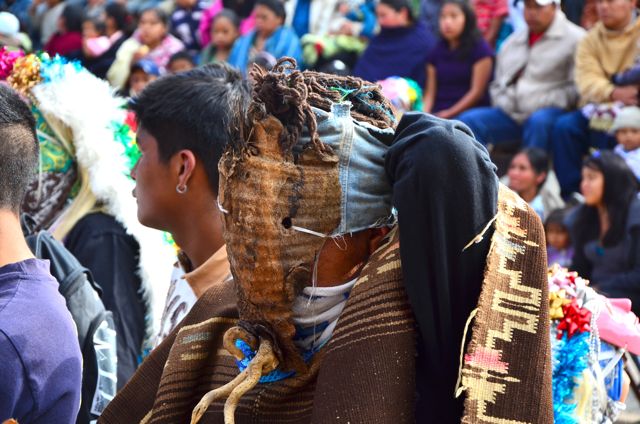
Having said all of that I want to describe an event we attended recently in which there was a competition of feo dancers.   So, the dance wasn’t directly connected to a another more serious dance although at the same event there was a competition of Kurpites dancers, a dance which is indeed serious and beautiful.   I was not sure quite what to expect but to our surprise there were only one or two masks of the rubber-monster type.   The remaining 30 masks were hand made, which is not unusual, but were made of the products of their immediate environment.  The pueblo is located in a stunningly beautiful area of mountains and thick forest.  The masks were made of wasp nest, wood, bark, maguey, deer’s head, sheep’s head and more.   One dancer carried a 5-6 foot snake (recently alive) and another carried a stuffed owl holding a squirrel.

The dancer with his head down is carrying a 6' snake.
This mask is made of a section of maguey.


Now,  the punch line.  Our informant told us that the feos danced to bring on rain.   If by the middle of May there was no sign of rain, the feos would be called up.   Rain dances are not uncommon in Mexico and usually take place around Easter or in May.  I am not sure how the dance is too change the minds of the gods and let the rain appear.  Do the masks scare the gods?  Do the masks enthrall the gods so the rain can sneak by them?   Are the gods pleased by the dance and thus return the pleasure in the form of rain?   It turns out the process is similar to asking a favour of the Virgin of Guadalupe; the dance itself is a form of petition.  One can see why the indigenous peoples took so readily to the new European religion.   What we saw was a competition of dancers but the real dance of the feos would be danced during the night